

Here, WALTER CRONXITE uncovers the report which shows that Viridor’s £1bn incinerator was never as good a deal as they told the planning authorities

Sue Riddlestone: BioRegional’s CEO and key witness to Sutton’s incinerator decisions
Individual homes in a Barratt’s housing project could each face additional bills amounting to £10,000 if they are linked to a heating network as proposed by Sutton Council, according to a suppressed official report.
The Liberal Democrat councilors who run Sutton even expect the unfortunate residents of the supposedly ecologically friendly Felnex development to pay for their fuel supplies from the Viridor incinerator under construction at Beddington at a rate seven times greater than the council itself pays its energy suppliers.
The incinerator is being built as part of a 25-year deal, worth £1 billion, with the South London Waste Partnership, a body created by Croydon, Sutton, Kingston and Merton councils. Planning permission was granted by Sutton, where the incinerator is sited, only after extensive official lobbying, in which the case was made that rather than just burning rubbish, the Viridor plant would be an “Energy Recovery Facility”, an ecologically friendly marvel that would provide cheap heating for homes in Sutton and Croydon, thus balancing out any environmental damage caused through emissions and pollution.
But a report by Sutton Council’s own partner, BioRegional, demolishes any idea of a financially viable heat network in Hackbridge. Mysteriously, Sutton Council chose to ignore this fully costed and well-argued report, and have allowed it to gather dust, in the hope that no one would notice. Hard luck, Sutton…
When, in November 2011, SLWP named Viridor as its preferred bidder for a 25-year £1-billion waste contract, it started a series of reports and consultations. These ensured Sutton Council would choose blighted Beddington as the site for the incineraror
On March 6, 2012, Sutton’s scrutiny committee met to discuss the waste contract and the Viridor incinerator proposal. Sue Riddlestone, the chief executive and co-founder of BioRegional, was a key witness.
BioRegional is a Hackbridge-based environmental charity that was already working closely with Sutton to deliver its “One Planet Sutton” scheme.
Riddlestone told that important committee that BioRegional had asked for a meeting with Viridor, to be chaired by the local MP, Tom Brake, at which they wanted to learn more about the “energy recovery facility”. She also criticised Sutton for its poor recycling rate of just 35 per cent. The higher the recycling rate, Riddlestone reasoned, the less an incinerator can have to burn.
Riddlestone’s written report stated that, “BioRegional was not an expert on this type of technology and there are several questions on health that need to be clarified.” She also expressed a preference for the community to have a stake in any district heat network.
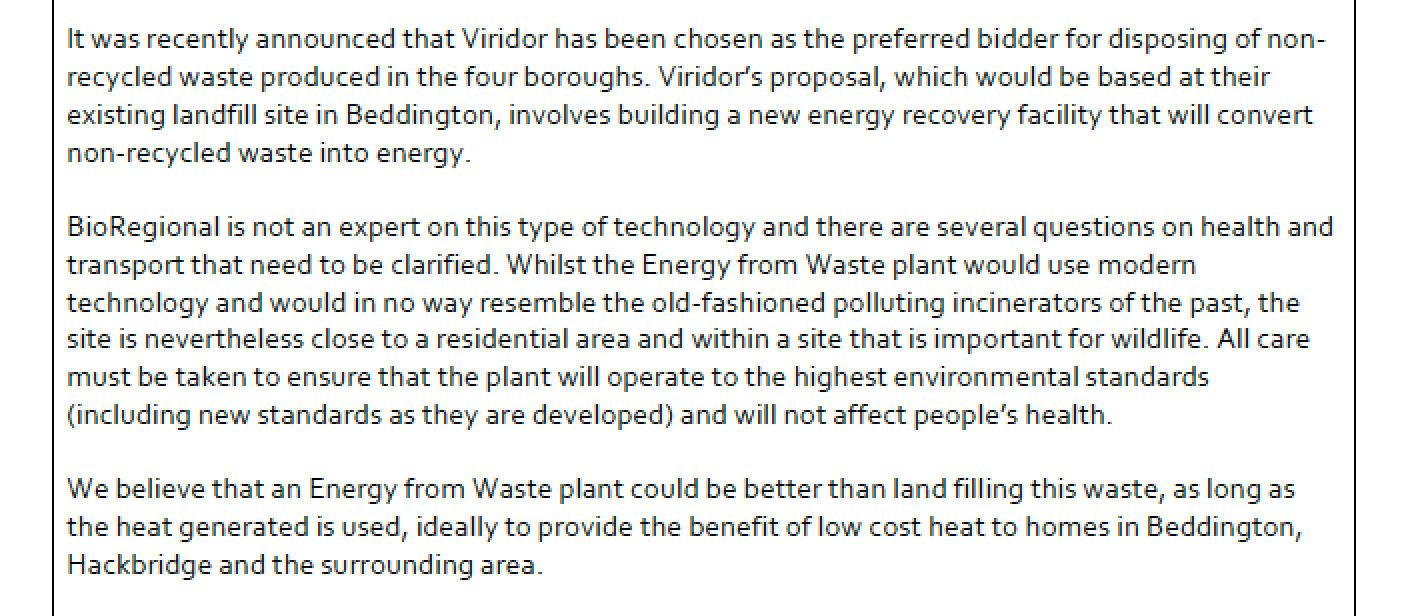
The text of Sue Riddlestone’s report to Sutton’s scrutiny committee in March 2012
The final scrutiny committee report was presented to Sutton Council on May 8, 2012, where it was adopted. The report emphasised that “the Council support the development of a decentralised energy network that benefits the local community in Hackbridge and Beddington in particular as part of the proposed Energy Recovery Facility.” Or what is known, in plain English, as the incinerator.
But all was not what it seemed.
When Riddlestone stated in evidence that her organisation had no expertise in the field of the impact of pollutants that emanate from an incinerator’s 300-foot-tall chimneys, two of BioRegional’s consultants were simultaneously working with Cherwell District Council in Oxfordshire. They were preparing a report on a heat from waste network from the proposed incinerator at Ardley to be built by… you’ve guessed it, Viridor.
Those consultants, Nicole Lazarus and Joanna Marshall-Cook, were BioRegional’s representatives on the Eco Bicester Strategic Delivery Board, and had been working on the scheme since 2010.
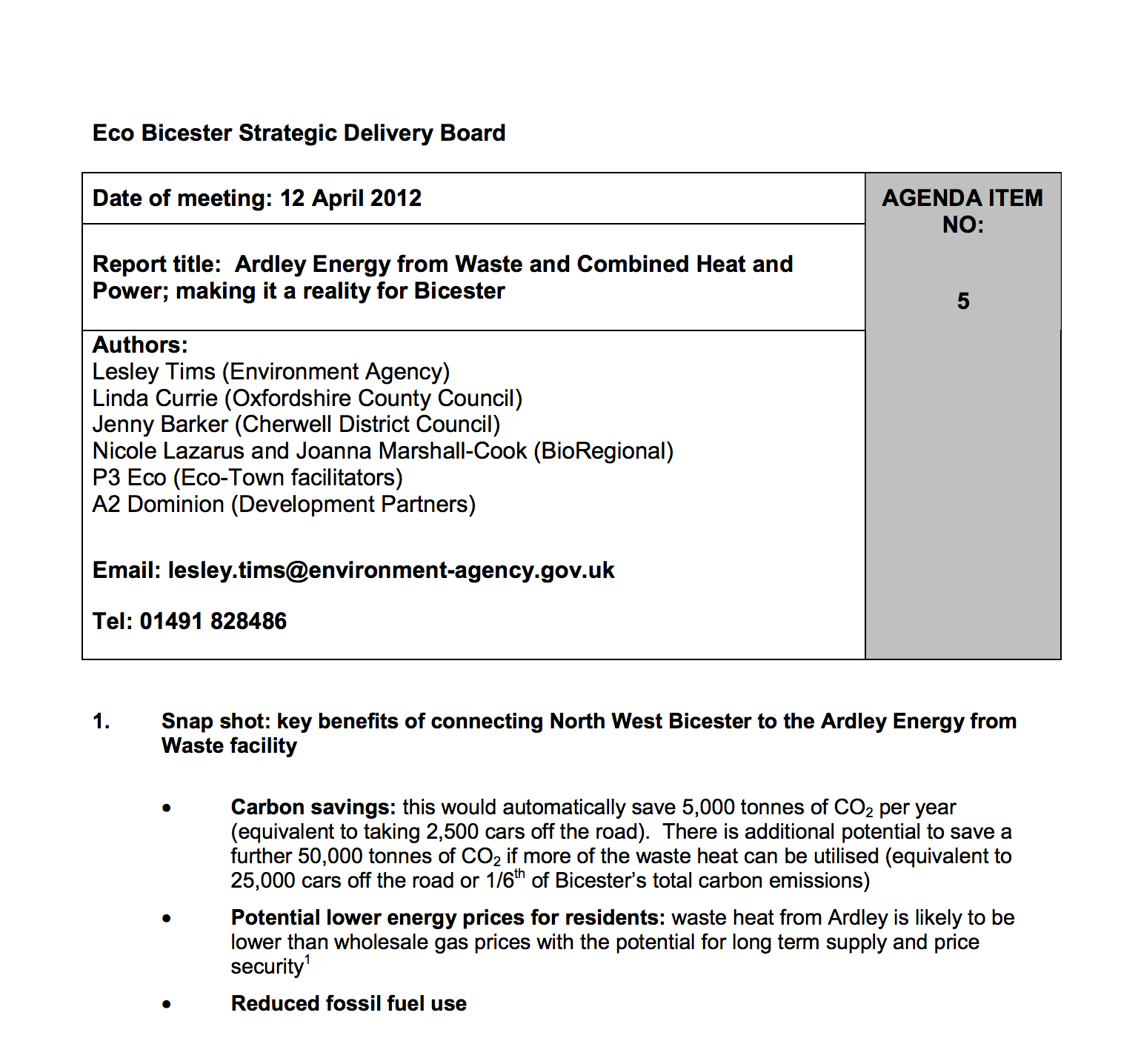
BioRegional had been working on Viridor incinerator schemes before Beddington
This conveniently overlooked fact was not the only occurrence of forgetfulness from BioRegional regarding its expertise in local heat networks.
Inside Croydon‘s loyal reader will see from this extract of the Bicester report that a heat network will save 50,000 tons of CO2 per year. That would require connecting to around 40,000 homes. The problem with that is that the only around 30,000 people live in Bicester. Never let the facts get in the way of claims for the environmental benefits of a vast rubbish burner, eh?
While Riddlestone was addressing Sutton Council, her BioRegional team completed a report entitled Retrofitting District Heating Systems: Creating Replicable Retrofit Models in Hackbridge.
The existence of this report has only just been revealed by Sutton councillor Nick Mattey. Mattey has developed an uncanny knack of digging up material about the Viridor incinerator which Sutton Council appears to want to bury with their land fill – Mattey’s campaigning actions have seen the embarrassed LibDems who control Sutton get him expelled from their party.

All you wanted to know about heat networks but were afraid to ask
BioRegional’s detailed and thorough report was funded by The Climate Change Collaboration, an arm of the Sainsbury family charitable trust.
It carries Sutton Council’s logo on the cover and was based around the Hackbridge “zero carbon suburb” that was part of BioRegional’s idealistic partnership with Sutton.
It is inconceivable that Sutton Council did not know about the report or its content. It was published in April 2012.
A press release issued on May 1 that year by BioRegional stated: “the study would define a retrofit strategy for Hackbridge, and looked at the cost and delivery implications for a district heat network”.
The report includes analysis and detailed costings for such a scheme and addresses the practical problems that would snag any proposed heat network. By this time, proposals to build Felnex, a new-build of 725 homes and a supermarket, were already well-formed. Felnex homes were targeted as the ideal recipients of any district heat network.
But the report with Sutton Council’s badge on it concludes that for any scheme to be economically viable and environmentally sustainable, the heat from the incinerator would have to be almost cost-free. It said that retrofitting a heat exchanger to existing properties would require large subsidies. Typically, a connection cost of £2,500 per flat would have to be spent.
In other words, any prospective customers for retro-fitting the heat network would have to throw away their existing boiler, pay Sutton Council £2,500 to be connected to the “cheap heat” system, and then look forward to spending up to £300 extra per year for decades to come their heating.
Such conclusions are clearly damning.
While supplying energy to a new build might just about scrape by – and this, mind, at 2012 energy prices – the report concluded that retro-connecting any further properties was pure folly.
It said: “The overall heat demand is not sufficient to generate enough profit over 25 years to match the initial investment, even if the heat could be bought for 1p per kWh.”

The Sutton Council report which ought to have damned the heat network as not viable, and therefore rendered the incinerator unsustainable environmentally
The report suggested that other energy measures, such as insulation, would be better investments. This makes obvious sense, as in 2012 very few of Sutton Council’s own properties then met recommended standards for insulation and energy efficiency. Even today, according to Sutton, none of its 6,000 council properties reach A+, A or B ratings.
Meanwhile, in July 2012, as part of its planning application for the incinerator, Viridor produced a planning support statement which combined reports from consultants including Mouchel from 2010, one produced by Fichtner in July 2012, and others from ERM and Lagan.
It is the Fichtner element of the report that is concerning.
Viridor’s own planning support submission, which included troubling cost conclusions from their own consultants
The BioRegional report states that: “In order to pay off the capital investment within 25 years, an additional £150-£300 per flat would be required per year.”
The Fichtner report was long, and very frothy.
It trumpeted an annual return of 15per cent, a £6.6million per year income stream, and bare bones figures on a minimal £1.5million infrastructure investment required by the “Esco”, or energy supply company, now nominally Sutton Decentralised Energy Network (SDEN).
The proposed residential end user cost for energy was given as 4.2p per kWh, with Viridor supplying at 1.5p per kWh.
This now seems like a complete fantasy, as Sutton Council’s latest SDEN financial model suggested a 14.4p per kWh end user tariff is needed. Sutton admitted at Monday’s council meeting that it pays less than 2p per kWh for its own energy bills.
These alarm bells should have been ringing four years ago.
No where was there any real detail on the thorny problem of actual costs in delivering a heat network to new-builds or, especially, retrofitting old buildings, the basis upon which the claims for the long-term returns were made.
Viridor claimed that the Fichtner report demonstrated a strong plan for district heating, with more than enough customers available to generate income and a return of 15 per cent to justify the infrastructure investment required.

The Fichtner report should have set the alarm bells ringing long ago

Consultants hired by Viridor, unsurprisingly, stated that there’s a strong case for the Viridor scheme

The report carefully over-stated demand for the heat network, and understated its likely costs
But these statements contradicted the earlier BioRegional report, which continued to be buried deep on the BioRegional website.
What makes this apparently deliberate sidelining of Sutton Council’s own report with BioRegional even more alarming is a particular extract from the Fichtner report. It describes how Fichtner attended a meeting at the BedZed housing project in Hackbridge – which is supposed to be a environmentally leading scheme, where BedZed stands for Beddington Zero Emissions Development. Geddit?
Also attending the meeting were representatives of Sutton Council, BioRegional and the Hackbridge and Beddington Corner Neighbourhood Group (HNDG). The meeting – which must have taken place earlier in 2012 – discussed how BedZed itself, where BioRegional is based, could link to the heat, and identified several sites suitable for retrofitting, such as St Helier Hospital and flats in Hackbridge.
This was of course in complete contrast to BioRegional’s own report that decided the economics of retrofitting district heating simply did not work.
Meanwhile, Sutton Council chose to commission a report from academic and AEA Technology consultant Mark Broomfield to scrutinise Viridor’s planning proposals. This centred on the environmental impact and paid little attention to district heat economics. Anyway, Sutton Council’s eyes were already popping at the promise of a juicy 15 per cent return and a £6.6 million business.
The big question is why did Sutton Council completely ignored the report from BioRegional, which carried its own logo, and which that trashed the economical and practical viability of a local heat network in Hackbridge?
And why did BioRegional ignore the results of its own report when dealing with Viridor, Sutton Council’s Scrutiny Overview Committee, and Fichtners?
Intriguingly, when BioRegional’s CEO Riddlestone addressed Sutton’s development control committee in the final stages of the planning process, in May 2013, she did not do so as a BioRegional representative, but as a speaker for the Hackbridge and Beddington neighbourhood group. Was this another attempt to down-play BioRegional’s role in the process, and avoid any attention to its report?

At the planning meeting in May 2013, Sue Riddlestone did not speak on behalf of the council’s environmental partners, BioRegional
Sutton Council’s spending with BioRegional since 2011 makes for interesting reading. The cold figures might suggest that Sutton Council is the sort of customer which BioRegional would not wish to lose:
2011-2012 £119,454
2012-2013 £258,888
2013-2014 £286,871
2014-2015 £182,951
2015-2016 to date £6,528
Given Sutton Council’s close relationship with BioRegional, including a large retainer paid for the “One Planet Sutton” promotion and audit, and hundreds of thousands of pounds of other work including the plagued Hackbridge road junction redevelopment, it seems impossible that both parties were unaware of the report’s existence.
A cynic might suggest this is because the report’s conclusions were damaging to Sutton’s and Viridor’s whole plan for a local heat network, but even more damaging to Viridor’s planning application which demanded the inclusion of a combined heat and power network.
It’s worth noting that in late 2014, when BioRegional updated its website – while the Judicial Review into the planning permission granted to Viridor was being prepared to be heard at the High Court – and the reference to Hackbridge was removed from the title of the report’s description. This was not done for other reports, which retained their full descriptions. Odd that.

BioRegional’s website removed reference to “Hackbridge” from the title of its 2012 report. This will not have made a search for the document any easier
For future reference, we’ve downlaoded the full report, and it is available here in pdf format.
In terms of governance, it might be rude to suggest that a failure to consider the BioRegional report when putting together its plans for its Sutton Decentralised Energy Network business might be viewed as negligence by Sutton Council.
And what of SDEN’s managing director, Simon Woodward? Surely a man of his expertise and knowledge, as a director of an industry association, the UK District Energy Association, would be aware of the report’s existence, and would have considered it in his vital calculations?
Perhaps of immediate worry to Sutton Council is that the emergence of this suppressed report could have had a significant impact on the Judicial Review which was brought by Croydon Green Party activist Shasha Khan.
Khan challenged the planning permission on several grounds, but one was particular to the heating network element of the planning. In rejecting Khan’s Judicial Review appeal, Lord Justice Sullivan said he was “reasonably certain” that a combined heat and power network would be provided, as required by the planning permission, even though the precise routes of the necessary pipelines had not yet been provided.
If his Lordship had been able to see the BioRegional report, would the ruling have been the same?
Inside Croydon understands that Khan is consulting lawyers to ascertain whether the BioRegional report should have been presented by Sutton Council and Viridor under the important evidence discovery rules, and if not, whether there are grounds to review the decision or take an injunction against the council and Viridor, as building work on the incinerator continues at Beddington Lane.
Watch this space.
- Still Croydon’s only independent news source, and based in the heart of the borough: 1.97 million page views 2013-2015
- Inside Croydon: Named among best regional media campaigns, 2014
- If you have a news story about life in or around Croydon, a residents’ or business association or local event to publicise, please email us with full details at inside.croydon@btinternet.com