

JOHN JEFKINS wants to take you on a journey. Not one of those metaphorical businessspeak ones, but from Land’s End to John O’Groats in an electric car – without paying a penny for charging

Horsepower: John Jefkins reached the Kelpies at Loch Lomond from Croydon without spending a penny on fuel
Nine hundred miles in three days, stopping at Ironbridge and Selkirk en route, via Bristol to change co-drivers.
Could we drive VW’s ID3 electric-powered car from Croydon to Land’s End then on to John O’Groats with free charging all the way? That was the Jefkins family challenge to ourselves.
We are converts to an electric car. We bought it late last year but have done little more than lots of day trips since.
We’d still done 7,000 miles though, using a home charger to top-up its 260-mile range for a cost of about £3 a week – using 5p/kw hr for overnight tariffs like Octopus Go.
Free of lockdown, this was our first chance to get away and stay in hotels.
What better than driving from end to end of Britain?
The challenge was to do it for free, exploiting a subset of the UK’s charging network where VW offered free charging, plus the free overnight charging offered by hotels to customers (such as at Best Western).
Starting grid: John and daughter Lucy, having driven from Croydon, about to set off northwards
Starting on the weekend of the G7 meeting last month, we passed about 500 policemen getting off their Lancashire tour buses to stand around a roundabout on the A30 near St Ives armed with nothing more than yellow vests.
President Biden might have been more impressed by the four lethal-looking long-horned cattle that blocked our way three days later in the north of Scotland.

We took three days, mixing motorways and scenic driving, to stop in Ironbridge and Selkirk en route to a John O’Groats hotel called “Sea View”. And our room really did have a great view of the Orkney Islands – even until almost midnight.
We charged up overnight in Fowey Valley Best Western, while having coffee at Ionity Cullompton Services and overnight at Best Western Ironbridge.
We then spanned Ironbridge to Selkirk, charging a bit in Preston and a lot at Gretna Green, in order to get from there to Perth and avoid paying a Selkirk hotel £10 for using their charger.
Free power: there’s a surprising number of sources of free car charging the length of the country
Finally to John O’Groats, we had lunch in Aviemore where a ChargePlace Scotland charger was also free.
Thus, we charged the car about every 200 miles (while we were sleeping, eating or drinking) and arrived with 90 miles range to spare.
We paid nothing to charge on the whole Croydon to Land’s End part of the journey, nor on the section to John O’Groats (and we then spent the next week slowly heading homeward, visiting Loch Lomond and Yorkshire).
As we’ve found, even if you do pay to charge, it’s about one-third of the cost of petrol for a similar mileage. But you do need to shop around the large choice of networks and pay by energy, rather than time. Contactless payment works best, too.
Our experiment was to find out if we’d suffer “range anxiety” on a long trip and how our behaviour would change.
And it did. We found ourselves “grazing” for power, checking if the places that we wanted to go to also had cheap charging.
Our cars are parked for 90 per cent of the time. We’ve found ourselves looking for opportunities to charge up during those down times.
So, you have to ask, why in the future would people want to charge up their car at a petrol station that has no restaurant, coffee bar or shops attached to it? Instead, they will want to charge up near their home (as we do once a week), or be attracted to hotels, restaurants or shops that offer cheap charging. Will any petrol stations exist soon?
It has quickly become clear tous how cheap they are to run. They are so much more efficient than petrol or diesel, where 60 per cent of the energy is just turned into heat.

Monster trip: the Jefkins comfortably made it to Loch Ness
Since buying our VW ID3 (the replacement to the Golf) last year, we’ve mainly charged it at home using overnight tariffs – paying £3 or £4 to add the same 200 miles it used to cost us £40 to buy petrol for. Servicing costs are cheaper, too, with no oil, clutch, exhaust or much else to go wrong.
Yes, the charging network isn’t yet perfect. Some service area chargers are unreliable, so it’s worth checking reports on an app called ZapMap to avoid them. But we’ve found cheaper running costs (plus no road tax) can save almost £10,000 over petrol cars over three years for a 10,000 miles per year motorist with a home charger and overnight rate.
But how about “range anxiety”?
We found that every 150-200 miles, you typically want to stop for the loo and a coffee. Within 20 to 30 minutes, it’s normally easy to replace that range in electricity using fast chargers. Slow 7kw ones are fine at hotels overnight.

ZapMap: inevitably, there’s an app for your phone
You can also charge cars from three-pin plugs – but it takes ages. Which is okay if you’re visiting granny, which is perhaps why it’s called “granny charging”.
We’d recommend ZapMap. You can filter the choice of charges, by speed or plug type – and for most, even see if they are working or currently in use. As there are already twice as many chargers as petrol stations, it’s easy to ensure you have a backup option.
My main complaint to VW is that this kind of information should be available on the in-car SatNav. VW are still displaying useless petrol stations on their electric car screens in bright colours, while chargers shown in an obscure grey!
Why would an electric car driver want to be shown where a petrol station is? SatNavs need to catch up.
So, ahead of our long trip, we did find ourselves using ZapMap before we set off to plan out what chargers are available at places we might want to stop or go to. And you do find yourself gravitating towards places that offer cheap overnight or fast charging. Tourist attractions take note.
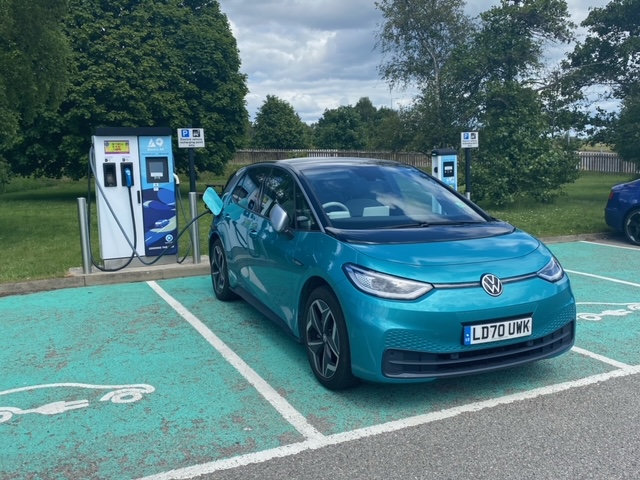
Free charge: the Jefkins found charging points like this, on the A9 in Scotland
With the choice of electric cars growing, the relative prices of the vehicles dropping (the ID3 costs about £32,000) and running costs savings of about £3,000 per year, I see a tipping point coming very soon when few will want to buy a new petrol or diesel car. In any case, we’re eight years away from when you won’t be able to buy a petrol or diesel vehicle: they will be banned from sale in the UK from 2030.
In Norway, that old internal combustion engine market has already dropped to only 10 per cent – and they are probably only three yrs ahead of us. By the way, one of the ZapMap social media terms you pick up is the term “ICED”, to mean that one of those museum piece cars has been parked in an electric bay.
I don’t think that we will be waiting for the tipping point until 2030. It’ll take only three or four years to start happening. After that, petrol cars won’t retain their resale value and the real “range anxiety” will be in finding rural petrol stations that are still in business.
I was driving a petrol car last autumn. I’m all new to this. But it’s quite clear what is happening when you try it for yourself. It’s easy to save thousands and there are plenty of options for either slow overnight or fast en route charging. Car choice is improving, ranges of 300 miles are common and electric and petrol vehicle price parity is coming soon.
But most people will want to charge up once a week somewhere they currently park their car, at home or at their office. That’s fine for people with driveways who can add 7kw charging points: £300 government grants are only available for people who have driveways. That’s not fair for people without them.
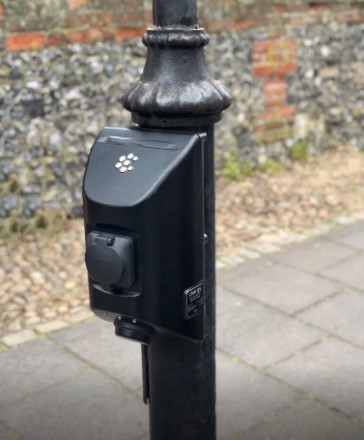
Croydon has lots of on-street resident parking. Our council could profit by providing lamp-post charging points (which need only be 7kw as most people would only need them for four to six hours per week, while parked in their street).
If the National Trust can offer free charging for just a £2 donation (as we found when we visited Fountains Abbey), and I can charge up in five hours at home for only £3, then Croydon Council could profit by charging, say, £6 per five-hour session.

Home free: the Jefkins road trip took them the length of Britain without having to pay to charge their VW
Each pair in each road without driveways could be shared by 40 cars a week – with profit from each one supporting our Council Tax.
There are hundreds of such roads in Croydon alone. They could charge an admin fee to pre-book sessions, too, while perhaps charging premium rates to those without a residents’ parking permit. And that would still be just a fraction of the price of petrol.
The question for ur council is will they profit from converting lampposts to chargers in roads without driveways, or will our pavements be criss-crossed with trip-hazard “granny charger” wires from three-pin plugs in each house?
- If you have a news story about life in or around Croydon, or want to publicise your residents’ association or business, or if you have a local event to promote, please email us with full details at inside.croydon@btinternet.com

- Inside Croydon works together with the Bureau of Investigative Journalism, as well as BBC London News and ITV London
- ROTTEN BOROUGH AWARDS: Croydon was named the country’s rottenest borough in 2020 in the annual round-up of civic cock-ups in Private Eye magazine – the fourth successive year that Inside Croydon has been the source for such award-winning nominations
- Inside Croydon: 3million page views in 2020. Seen by 1.4million unique visitors
