

Malcolm Wicks, MP for Croydon for 20 years, died at the weekend. Here ANDREW PELLING, for a time a fellow Croydon MP, shares his own recollections of a much-admired figure
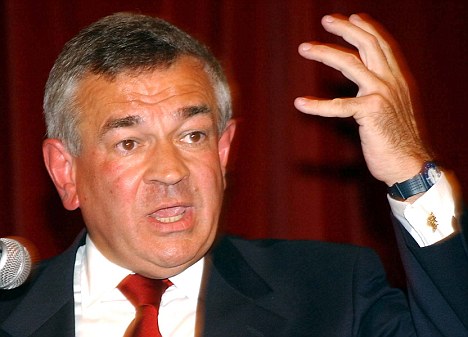
Malcolm Wicks: atypical as an MP with background outside of politics
Malcolm was atypical as a politician.
Malcolm Wicks came to politics with beliefs. He came to politics with a hinterland of pertinent knowledge.
Initially an academic, he already had a command over social policy issues when he reached the House of Commons when elected for what was then Croydon North West in 1992.
Malcolm was not among that dreary cadre of career politicians whose backgrounds are only ones in political hackery.
He was entertainingly masterful, too, in dealing with any petty taunts from local Conservative councillors who could not mind their manners.

Malcolm Wicks gives his acceptance speech on being re-elected as MP for Croydon North
For Croydon Labour people, it’s hard to believe that he has really gone. Malcolm was determined to make light of his illness in his dignified combat with cancer.
Like many others over the past year after he made his diagnosis public, I was never sure as to whether to have the temerity to ask how he was. We all cared for Malcolm in asking that question but Malcolm just boasted disarmingly of how he was becoming so much lighter in weight than the person posing the question. So perhaps we never came to terms with Malcolm’s cancer.
As Malcolm became more svelte, his speeches were evermore rousing, and perhaps evermore radical.
That radical root can be traced back to Malcolm’s father Arthur Wicks, who was a conscientious objector and was long involved with London and local government. Wicks senior was the last chairman of the London County Council and served on the GLC until 1981. Malcolm wrote the obituary for his father in The Guardian.
Malcolm was very much a Croydon person, not that he overplayed that at election time. As a Sanderstead resident, he had been chair of Croydon South Labour Party before becoming an MP. He had a Guernsey link, having studied there where he met his future wife, Margaret, who is from Alderney. Malcolm good-humouredly put up with the eccentricity of my parliamentary office sending him a cache of creamy yellow Alderney butter after a visit there.
I first ran into Malcolm on General Election day in 1987 emerging from a polling station on the Rosedene estate near Mitcham Common. I was campaigning for the other side, Malcolm was standing for parliament for the first time.
When you look back it is very notable how the electoral topography has transformed while Malcolm has been north Croydon’s MP. In 1983, Labour came third in Croydon North West at the general election. A year earlier, aided by sentiment created by the Falklands War, all wards in the constituency were in Conservative hands.

Malcolm Wicks was an enthusiastic supporter of life-long learning, a topic for which he held ministerial responsibility during his career
But by 1992, Malcolm managed to overhaul Humfrey Malins, the genuinely socially aware Conservative MP, with a modest majority of 3.8 per cent.
Two decades later in a reconfigured Croydon North seat that included more Conservative inclined wards than the old Croydon North West seat, and Wicks was elected extraordinarily with a swing in his favour, even when nationally, his Labour party suffered a result in terms of share of the vote almost as poor as 1983. Croydon North had become one of the safest Labour seats in the country with a majority of more than 16,000 votes. Wicks took a quiet but definitely not boastful satisfaction in this electoral transformation.
Malcolm was willing to work with Croydon Council regardless of its political colour. Similarly, on Croydon matters, Malcolm was willing also to work across the floor with Conservative Croydon MPs.
While I respected Malcolm’s request for publicity to flow to him, we worked well together on issues like threats to Mayday Hospital and to Crystal Palace FC’s continued existence.
On his own, he did well to lobby with the then Labour Council for a flow of funds to re-generate Croydon. The funds were called LEGI and amounted to £77 million. The programme was cancelled in 2010 by the coalition government.
That’s not to say that Malcolm was unwilling to criticise public bodies in Croydon. A failing Mayday Hospital, the police after the riots, a thin council-backed report into those same riots – all were the subject of considered comments of concern as Malcolm insisted on working his way through the illness that had cursed him.
Malcolm was a solid party man but that was not a slavish approach. He worked locally for the pro-Alternative Vote campaign and subsequently teased Labour Party members who had campaigned “no” and for the conservatism that represented.
He was also hysterically funny in his speeches in mocking the local Croydon Labour party’s lack of familiarity in its own political literature with the concept of the possessive “s”.
Malcolm was a mature-minded serious politician who was well-regarded in the House by all sides. MPs rarely manage to get one piece of their own legislation through Parliament in the form of a private member’s bill. Malcolm managed to take two important items of legislation through the House.

Malcolm Wicks with the then MP, Andrew Pelling, united at a Greenpeace event at the Heathfield centre in 2009
The Carers (Recognition and Services) Act 1995 was the first recognition in law of the role of unpaid carers. Malcolm was close supporter of the Croydon Carers Centre.
The Co-operative and Community Benefit Societies and Credit Unions Act 2010 regularised the legal treatment of the burgeoning credit union movement based on co-operative principles. These pieces of legislation said much of where Malcolm had come from as a politician with a strong grounding in social policy, a grounding that made him stand out from political lightweights.
During the 1980s, before his election to the House, Malcolm had been the director of the Family Policy Studies Centre, so he was well-placed to comment on issues like social care, benefits and family break-up. He championed issues around fuel poverty, hypothermia of senior citizens and warm homes long before the issues became fashionable.
Malcolm applied his knowledge in government and widened his areas of expertise further with his appointments as minister for lifelong learning, minister for pensions and minister for energy, where he was an exponent of nuclear power.
Malcolm was an effective minister, it just seemed odd that he never got the call to join the Cabinet.
Malcolm was not a man of religion. That did not stop him from attending church services in his role as an MP, even if he demurred from reading lessons from the bible. It is hoped that his contribution to Croydon will be commemorated in due course.
In the interim, there is a book of remembrance open this week at his old office at 908, London Road just a little north of Thornton Heath Ponds.