

SUSAN OLIVER explains why Croydon needs to become a Transition Town
You don’t have to look hard to find bad news about the state of the planet today.
It could be all gloom and doom, but some people – including in Croydon – are organising themselves to stand up for the Earth and do anything it takes to bring about a change.
That organising has been made easier thanks to a movement called Transition Towns. TTs are about responding positively to the twin challenges of climate change and peak oil*.
TTs were first suggested by Rob Hopkins. Hopkins, a Briton, was a permaculture teacher in Kinsale, Ireland, eight years ago when the idea caught hold. He took the idea to Totnes, Devon, where he and others worked on it further. There are now 421 official Transition Towns all over the world and 566 more that are in the mulling stage.
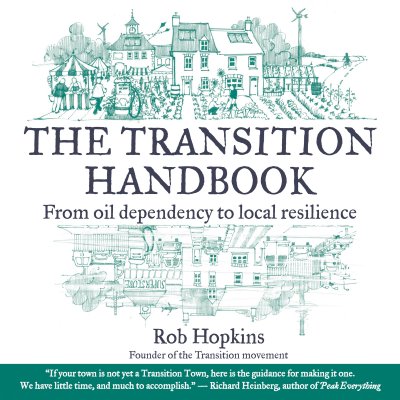
The Transition Town’s handbook, written by Rob Hopkins
A major activity of Transition Towns is to educate and discuss the realities facing the Earth. Another major theme in Transition is strengthening the community. TTs are named with their town or city’s name: Localism is at the heart of the movement; it’s about acting locally and getting to value one’s neighbour and town.
The oil-based economy has encouraged us to look away from our communities for our well-being. With the decline of physical resources, it’s time to look within and see our strength here in Croydon. What can we do to increase the town’s self-reliance? How do we develop cooperative networks that we may need to rely on in the future? With more extreme climate trends – despite drought warnings in April, 2012 was the wettest in England for a century; three of the wettest years since records began have happened since 2000 – we can’t be complacent.
TTs try to boost is resilience, which is a community’s ability to bounce back or just cope with less oil. This scenario isn’t hard to imagine for Croydon. Most of our food is trucked in by lorries, and a petrol price-war, strike or bad weather could precipitate a food crisis even before we encounter a long-term problem with fuel.
Transition works from the bottom up, meaning they don’t try to influence large governments or corporations. Instead, they take a grassroots approach and work with local people and businesses. Power is not sought after by influencing the upper crust; it arises simply as the result of people cooperating and valuing each another.
TTs are shaped by the individuals that make them up, and creative ideas for projects are being developed all the time. This is where vision comes in; that’s where you come in. What are your ideas? How can we encourage a culture that is less oil-dependent, more resilient and resourceful?
I must admit it’s difficult to know what to do. How does one change a culture? But at least it’s better than doing nothing.
TTs are not looking for leaders nor do they groom people for positions of importance; they cultivate the idea that everyone is important. And, as you may expect, Transition Towns are apolitical and are not connected to any political party nor do they endorse political candidates. We in Croydon know that this can only be a good thing.
I see the Transition movement as a response to a time when we desperately need some honesty about what’s going on with our world. This may start humbly – a community garden here, a movie night there – but underneath, what grows unseen is much more important.
* = “peak oil” has become short-hand for the fact that we have used up the easy-to-reach oil and are now scrambling to get what’s left.
- Susan Oliver (@beesnbeans on Twitter) is a gardener and bee-keeper who lives in Addiscombe.
- You can find more information about Transition Towns at: www.transitionnetwork.org
- Contact Croydon Transition Town at croydontransitiontown@gmail.com or on Twitter @croytransition . There’s already a Transition Town in Crystal Palace: www.crystalpalacetransition.org.uk
- Other near-by Transition Towns: www.transitionstreatham.org ; www.transitiontownbrixton.org ; www.projectdirt.com/group/transitiontownwimbledon
- For a complete list of Transition initiatives in London: www.london-transition.org.uk
- Inside Croydon: For comment and analysis about Croydon, from inside Croydon
- Post your comments on this article below. If you have a news story about life in or around Croydon, a residents’ or business association or local event, please email us with full details at inside.croydon@btinternet.com
Related articles
- Totnes economic blueprint: The first reports are now available (resilience.org)