

JOE PAXTON reports from Upper Norwood after the first week of controversial road closures which, despite predictions of doom and gloom, have not caused Armageddon
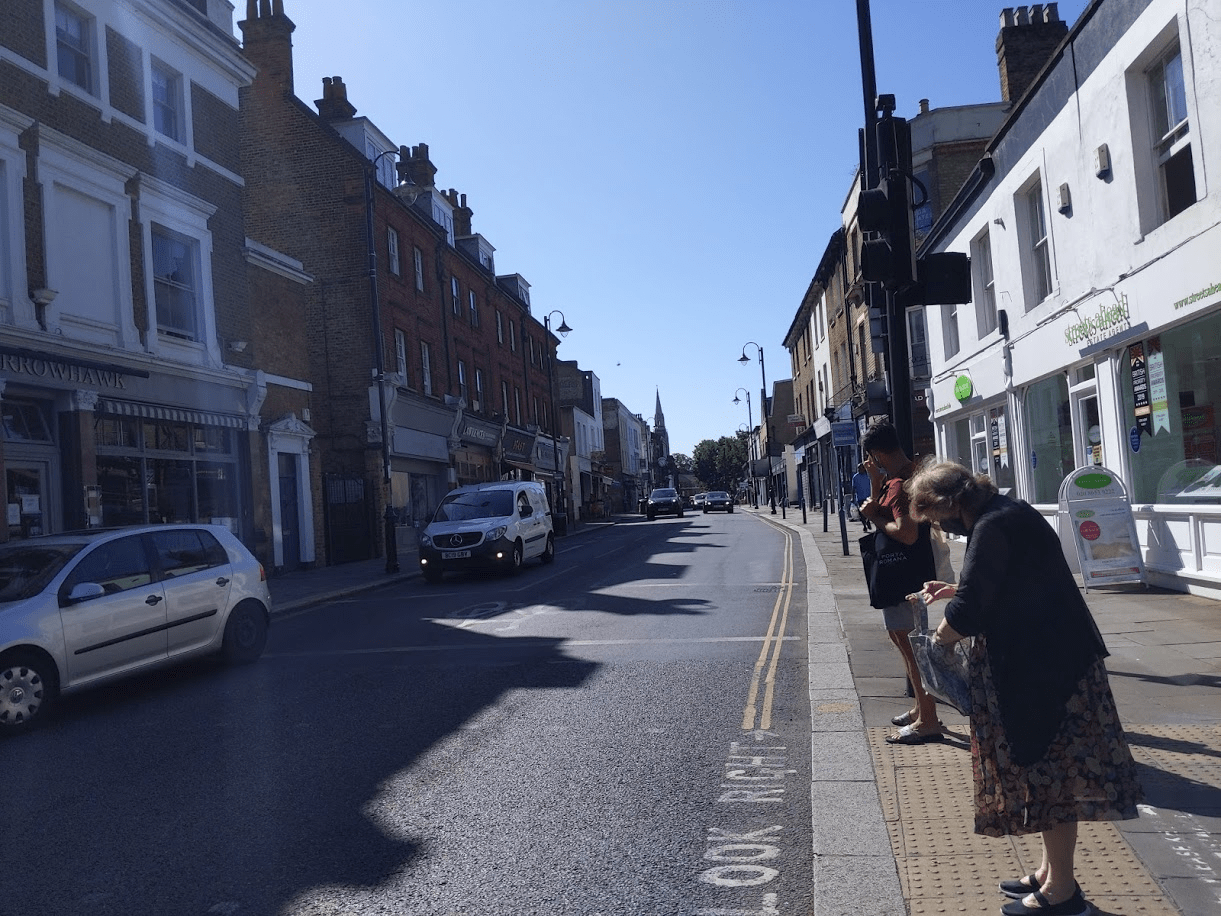
Crystal Palace yesterday afternoon: predictions of a traffic apocalypse seem wide of the mark
Local social media earlier this week was debating which of the Four Horsemen of the Apocalypse would arrive first on Church Road.
Yet despite some scaremongering and much angst, predictions of doom and road rage have not materialised, and many residents of the Low Traffic Neighbourhood introduced in Crystal Palace this week seem happy with it, to judge from news reports and conversations we have had.
With traffic limited to residents and deliveries, the streets are quiet. People report an experience like waking up from a bad dream: more walking, cycling (including children), not being disturbed from early in the morning to late at night by traffic noise, and such natural city-living activities as chatting to neighbours and strangers in the street.
Best of both worlds, the long-standing and inconvenient diversion of the essential 410 bus has ended. A “bus gate” means it can travel through the neighbourhood but private vehicles can’t, unless they are prepared to help solve the council’s financial woes by paying a hefty fine.
All this is a sharp contrast to the situation before the scheme was completed earlier this week.
The road closures affect Sylvan Hill, Stambourne Way and Fox Hill, side roads that link the major roads at Church Road and Auckland Road.
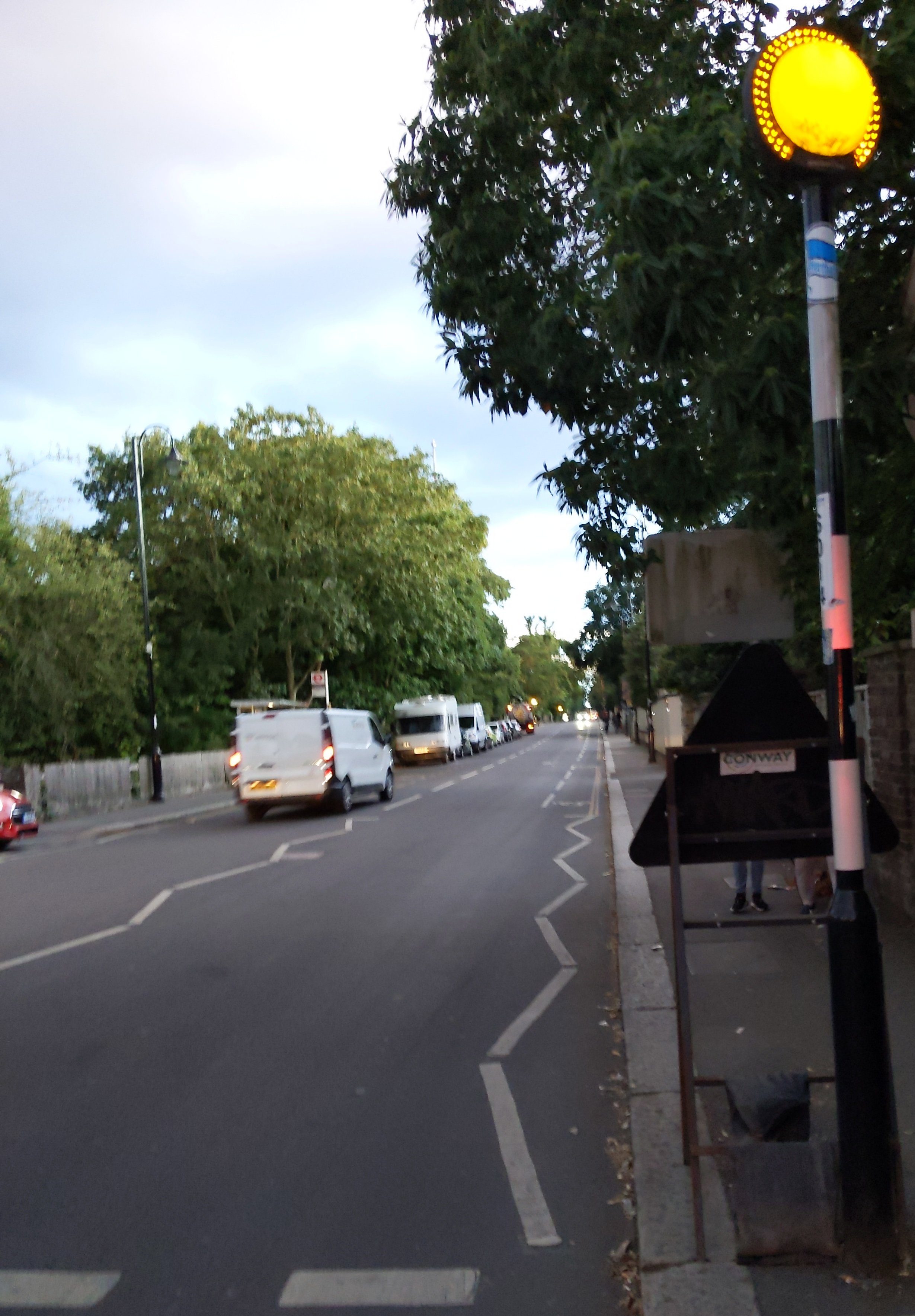
Free-flowing traffic on Church Road earlier this week, despite the predictions of doom
Fed-up residents had counted the traffic and found more than 6,000 vehicles a day on the busiest roads, almost all using residential side streets as a “Triangle by-pass” during longer journeys. A survey of residents found, predictably, concerns about air pollution, noise, asthma, sleep, mental health and traffic danger. This was especially so for those not nimble enough to cross side streets which had become as busy as main roads, but lacking formal crossings and other safety features.
Contrary to the assertions of its opponents, the LTN is not a “small, leafy, rich, enclave”.
It extends from South Norwood to Anerley Road and the Crystal Palace Triangle. It is nearly a mile and a half north to south, and up to half a mile wide. Parts at the Anerley end are in Bromley. Around 10,000 people (2011 census) live in it. It contains a large council estate, as well as a secondary school, which generates school run traffic but to which a lot more pupils walk through the area, and a primary school.
And according to that last census, around 40 per cent of households in the area do not have a private vehicle, so up to now have been experiencing all the downsides of unrestricted traffic without any of the benefits. Those who don’t own cars tend to be the poor, BAME and disabled.
Up to now, the main burden of through traffic has fallen on the spinal route through the neighbourhood – Hamlet Road, Auckland Road and Lancaster Road, and some streets connecting it to the main roads. Other streets, cul de sacs and the Auckland Rise Estate, are quieter, but their residents have still had to experience some of the noise of the busier routes, and fumes and danger of the busier roads which they would need to use to enter and leave the area.
‘Just on my way to Sainsbury’s Westow Street to buy some milk and a jar of coffee’
Why, then, are so many residents in and near the area, and drivers from as far away as Chislehurst and Newton Abbot, so upset about the scheme?
Within the area, some are having to drive further to get around the road closures, though in most cases the extra distance would be well under a mile.
Some of the suggested problems have been laughable (“Croydon people are now having to drive through streets in Bromley”. Oh the horror!), including suggestions that ascending the 250-foot (at most) elevation of the Norwood ridge from the lower ground around is comparable with scaling the North Face of the Eiger.
The main argument of the opponents, however, is that the vehicles which have been passing through the neighbourhood have been diverted on to main roads. This, they say, will add to existing congestion. This, they claim, will cause more pollution (it is always assumed that vehicles only pollute when they are queuing). The congestion will mean customers (who are always assumed to be driving) will stay away from businesses on the Triangle.
All of the links in this logical chain seem to owe more to that false friend, “common sense”, than to any real evidence. Nationally and internationally, traffic has disappeared after the introduction of such low-traffic schemes, as people make other choices of route or means of travel. Part of the point of such schemes is to help change people’s polluting habits, to gently get us out of our cars for all but the most essential journeys.
The main roads, particularly approaching and in the Triangle, are notoriously congested at some times, but not most of the time, even though there are currently some road works and blockages. Vehicles spew fumes and particulates when they are moving fast as well as when they are stationary.
Parking in and near the Triangle is so restricted, and other means of access so convenient, that it seems unlikely drivers are dominant among Triangle customers, especially as no one leaves many of the businesses – pubs and restaurants, hairdressers, boutiques and estate agents – having to carry anything too heavy, unless they have eaten a particularly stodgy pudding!
There seems to be no data to support that element of opponents’ arguments.
Residents with complaints are on stronger grounds on process. The council has been trying to do all this in the middle of a pandemic, and communications have been woeful. The process is meant to work via consultation during the experiment.

Cllr Stuart King: keen on safer streets
There is a good case for this, because it enables discussion to be based on actual experience, not the unprovable assertions of two opposing sides. But it does require both a clear plan to collect data before and after the road changes are introduced, quantitative and qualitative, and a process in which all people of goodwill, whether supporters or sceptical, can feel they have voice, and from which some intelligent adaptation to the scheme might emerge (for example replacing the fixed barriers with cameras allowing resident access).
Residents, on both sides, have been asking the council to make clear their intentions about this part of the process and have offered to help with legwork on a volunteer basis, recognising the council doesn’t have much money. Nothing has emerged so far.
It is to that which Stuart King, the council cabinet member for transport, and his colleagues should turn their attention as a matter of urgency, if they want their basic concept to succeed, and heal the community from the controversy to which his well-intentioned and promising, but fumblingly implemented scheme has given rise.
- If you have a news story about life in or around Croydon, or want to publicise your residents’ association or business, or if you have a local event to promote, please email us with full details at inside.croydon@btinternet.com

- Inside Croydon works together with the Bureau of Investigative Journalism and BBC London News
- Inside Croydon named Journalist of the Year at 2018 Anna Kennedy Online Autism Heroes Awards
- ROTTEN BOROUGH AWARDS: For three consecutive years, 2017, 2018 and 2019, Inside Croydon has been the source for award-winning nominations in Private Eye magazine’s annual celebration of civic cock-ups
- Inside Croydon had 1.6million pages viewed by 721,000 unique visitors in 2019
