

A council-commissioned report has been published on the borough’s response to the climate emergency. Say its authors, “The clock is ticking on climate change… we need to ensure that we are building an economy fit for the future.”

Here, PETER UNDERWOOD, pictured right, a member of the commission which drafted the report, offers his insight into its findings
In June 2019, following a campaign by local environmental groups, Croydon Council passed a motion declaring a climate and ecological emergency. Many councils did the same thing around that time but have since done absolutely nothing to deal with the emergency.
To Croydon’s credit, its declaration was the start of a process.
First, a climate Citizens’ Assembly was set up to bring in the views of a wide range of Croydon residents. The Assembly had meetings at the start of 2020 and came up with a set of key points and recommendations.
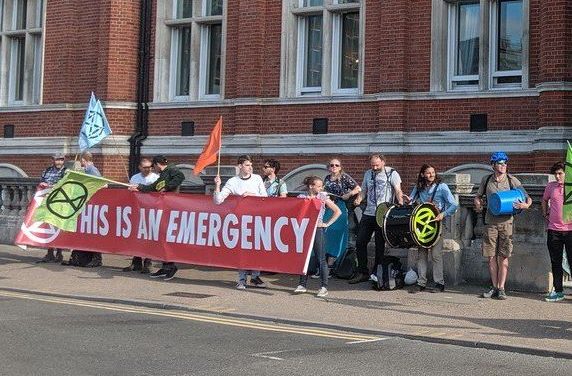
Extinction Rebellion and other activists took their protests to the Town Hall in 2019. Since when…
In March 2020, the next stage was to set up the independent Climate Crisis Commission “to work in collaboration with the council and the wider community, involve expert advice, and engage and co-produce with the people of Croydon, to drive forward radical action to decarbonise the local economy in a just and fair way”.
Croydon Council asked the New Economics Foundation to set up and support the commission. The Commissioners included experts in a wide range of areas and they set up working groups to bring together experts and local residents to further develop recommendations for the council.
As we all know, March 2020 was also when the country went into the first lockdown of the coronavirus crisis. This has had a huge impact on the work of the Commission and has meant that producing this report has taken far longer than was planned, we have not been able to consult as widely as we wanted, and none of us would claim that this report is a comprehensive list of everything we need to do in Croydon to tackle the climate and ecological emergency.
But the key word here is “emergency”. We all know that the time we have left to act is getting shorter and so we need to act now.
The report doesn’t cover everything but it does set out a series of recommendations that we can start to act on straight away to move us in the right direction.
The recommendations are set out in five groups:
1, Getting the groundwork right

How much real progress has Croydon Council made in two years since Tony Newman went all David Attenborough on us?
The Commission’s recommendations cover a broad spectrum of climate adaptation and mitigation actions that are designed to be fair and drive up living standards.
Each recommendation must be implemented with a robust and effective action plan, bringing together a strong alliance of partners and using transparent decision-making processes.
Critical to this implementation is monitoring the council’s progress in tackling the climate emergency to ensure its actions are having an impact and delivering the required results.
2, Driving a green economic recovery
The council needs to ensure Croydon residents have access to good quality jobs created through investments in green sectors. The council must promote the training of workers to develop the new skills required and ensure the local economy is resilient, vibrant, and working for the residents of Croydon. Investing in a drive towards a circular economy will create new economic possibilities that design out waste, improve natural environments and recirculate used materials.
3, Greening our neighbourhoods

‘The council should reduce the need to travel, influence the type of travel’
To drive rapid carbon reduction in our neighbourhoods, the council should reduce the need to travel, influence the type of travel adopted by residents and businesses, and improve energy efficiency in homes, public and commercial property to reduce their energy use across the borough.
The council can provide certainty for retrofitting businesses by creating a pipeline of work through social housing and increasing confidence for homeowners to make changes to their properties by identifying local trusted tradespeople.
4, Getting people and businesses involved
To realise its ambitions, the council will need engagement from Croydon residents, employees and businesses. This will require both awareness-raising activities across the borough about the actions residents, employees, businesses, trade unions, and other local organisations can take, and engagement activities to inspire people to take action.
5, Achieving the scale of change
Croydon Council is directly responsible for between 2 per cent and 5 per cent of the area’s production-based carbon emissions.
The council can also significantly reduce other emissions through its services, planning, enforcement roles, housing, regeneration, economic development activities, education and skills services and investments. However, to deliver the net-zero ambition will require local-level action to be supported by regional and national government action and the council has a role in lobbying to make these changes happen.
The full set of recommendations can be found in the report here.
As the New Economics Foundation has said: “Croydon Council needs to show leadership… It cannot achieve the scale of change required within the necessary timeframes without the whole system working together: education, skills and wider public sector organisations; businesses, employees and trade unions; the community and voluntary sector; and local residents.”

The report suggests that the council’s target of net zero carbon by 2030 seems as far off as ever
The council could reel off a list of things it has already done, but realistically this has just been tinkering around the edges. As this report sets out, achieving the goal of being carbon neutral by 2030 needs far-reaching and significant changes.
And most importantly, this report is not an end point.
If Croydon Council really wants to tackle the climate and ecological emergency, then this report should lead to an ongoing process. We need to engage with even more people and provide a way for residents to hold the council to account and make sure they continue to make progress towards carbon neutral by 2030.
So this is the challenge to the council cabinet meeting next Monday which will consider the report and its recommendations: Will this report just get ignored or lost in a pile of excuses for not delivering? Or are you willing to take the bold steps and set an example to other councils of how to take a lead in delivering real and significant change?
Read more: Report: Incinerator is ‘as polluting as coal-fired power stations’
Read more: Town Hall protest over climate commission’s wasted time
Read more: Extinction Rebellion challenge Newman’s hypocrisy on climate
Read more: Labour councillors ‘shocked and appalled’ at incinerator link
- If you have a news story about life in or around Croydon, or want to publicise your residents’ association or business, or if you have a local event to promote, please email us with full details at inside.croydon@btinternet.com

- Inside Croydon works together with the Bureau of Investigative Journalism and BBC London News
- ROTTEN BOROUGH AWARDS: Croydon was named the country’s rottenest borough in 2020 in the annual round-up of civic cock-ups in Private Eye magazine – the fourth successive year that Inside Croydon has been the source for such award-winning nominations
- Inside Croydon: 3million page views in 2020. Seen by 1.4million unique visitors
