

The residents’ fight-back against over-development continues, despite efforts by an external legal adviser to get councillors on the planning committee to alter their rulings. By STEVE WHITESIDE


Dire warnings: Richard Barlow, of Browne Jacobson, is a new face at planning meetings
A year ago, I suggested on these pages that there might be “glimmers of hope” that the council’s planning committee might finally have had enough of the misleading nonsense regularly served up to them by council planning staff when defending their recommendations to approve some of the more egregious schemes put forward by profit-hungry developers.
There have been more straws in the wind since, especially after the planning committee’s composition changed in May and Michael Neal (in the Blue corner) was given the chair’s casting vote.
But there was an incident before that which was perhaps of equal significance with regard to the proper conduct of these meetings, at which the “management” of approved applications is regularly delegated back to the officials via the long list of “conditions” attached to permissions.
For many years, Sean Murphy, the council’s second-most senior in-house lawyer, and others from the democratic services department, had occupied the seat next to the committee chair at these meetings, usually barely opening their mouths all evening (and planning meetings often go on for four hours or more).


Planning adviser: the council’s former legal expert, Sean Murphy
Murphy and his colleagues were there because the council’s constitution said they ought to be… as long as they didn’t interrupt too much.
But the planning meeting on April 7 this year – before the local elections a month later, when the council was still under Labour control – saw a departure from usual practice, with the introduction of an external solicitor – that is, one hired in at no doubt considerable additional cost – “to provide legal support to the committee”.
Meet Richard Barlow of Browne Jacobson LLP.
One councillor (but only one) thought this was a bit “odd”, with “Thirsty” Clive Fraser – himself a former senior council planning official in Lambeth – asking why there was an external legal adviser at the meeting, rather than the usual in-house, council staff lawyer.
Barlow explained that (as he understood it), “Unfortunately the legal adviser who would ordinarily be in attendance at your committee is unable to be here today. I think there were other commitments for other colleagues within the legal department and so we were asked to assist and be here today.” Like the fortnightly planning committee meetings are not somehow a priority for council legal staff.
“We are holders of a framework contract to support you for legal advice and I have dealt with a considerable number of matters for the borough,” Barlow went on. “Some of you may recall that I provided training to the committee in May last year.”
When Councillor Fraser asked whether he had a background in planning law, Barlow confirmed that he had and that he was “a legal associate of the Royal Town Planning Institute”. Which is nice…


Come the planning meeting on April 28, and Barlow was there again.
This time there were no questions asked. Apparently, having a costly external legal adviser at the cash-strapped council’s planning committee was now the norm.
But if we had become used to in-house lawyers saying very little during meetings, for part of this meeting we were in for something very different.
When it looked as though the committee was about to refuse an application (21/01208/FUL – rear of 34 Arkwright Road in Sanderstead), Barlow jumped to the defence of the official, telling councillors, “You place the officers in an invidious position. They have publicly declared their position, and it is difficult for them to be asked to be seen to take a different line subsequently.”
The committee was reminded of the possible award of costs against the council if the developer behind the application was to appeal (what with the council’s finances in such a dire state and all that), and advised that “on the merits there is considerable risk that the decision would not be upheld at appeal”.


Huge and ugly: but 34 Arkwright Road was perfectly acceptable to council planners and Richard Barlow. The Planning Inspector, however, disagreed
What Barlow said next was priceless.
“What I would say just to make you fully aware of this – it is not uncommon in situations of this nature that those who seek to advance views which are contrary to the views of the officers are then asked to actually stay true to those views and put them at the subsequent enquiry, because someone has to give evidence in order to seek to substantiate any reasons which you may choose to propose are imposed as part of the decision-taking.
“Now I don’t know what will happen but you ought as members of the committee to feel ready, willing and prepared if you wish to advance those views to do so at an inquiry when you would be subject to cross-examination, and I can assure you from having been there quite frequently myself, it’s not the most comfortable of experiences you are going to endure.”
So according to Barlow, the rebellious councillors risked being grilled by barristers at a subsequent inquiry. Some of the councillors were not best pleased, chair Michael Neal included.
In the end, and despite Barlow’s dire warnings, the councillors refused the application on a single ground, that the proposal would be an “overdevelopment of the site that would have an adverse impact on the character of the surrounding area by reason of its scale, height, mass and density”. We’ve been here before. It was too bleedin’ big!


As is usually the case, it was agreed that the appeal would be decided not – as Barlow had warned – by some adversarial courtroom grilling by some latterday Perry Mason, but by written representations where the government-appointed Planning Inspector considers written evidence from the appellant, the local planning authority and anyone else who has an interest in the appeal.
There would be no inquiry. So what had Barlow been on about?
While we waited for the outcome, the planning meeting on June 16 was attended by one of Barlow’s colleagues from solicitors Browne Jacobson, Ben Standing, who introduced himself as “the legal officer to the committee”. I’m really not sure if that was quite right, but no one queried it, which I guess amounts to a “Welcome to the party Ben … whoever you are”.


Stand-in: Ben Standing, Barlow’s colleague at Browne Jacobson
A week ago, on November 3, Chartwell’s appeal was finally dismissed and the application for costs refused. Croydon councillors on the planning committee had got it right. The council’s planning officials and Richard Barlow of Browne Jacobson had got it wrong.
It is worth noting that planning officials had advised the committee that “The proposal is… of an appropriate form and mass for this site and a suitably high design quality which responds appropriately to its context.”
The Inspector saw things differently.
“The proposal would have an imposing contemporary appearance which would be significantly at odds with the overriding domestic scale and traditional vernacular of the site’s suburban surroundings.
“The design and scale of the building would be likely to appear particularly incongruous and out of keeping with its immediate context when seen from the rear of… neighbouring properties.” Our emphases.
According to the Costs Decision the appellant had argued that “the design of the proposal followed extensive discussions with the council’s officers and suggests that the council [meaning the planning committee] should have obtained external design advice before reaching its decision”.
The Inspector disagreed.
“There is nothing before me to suggest that the council’s planning committee did not have sufficient information before it, both in terms of the design of the development or the surrounding context, in order to be able to make an informed decision.
“Therefore, the council was entitled to reach its own conclusion on what is a subjective matter.”
Members of the committee must feel emboldened. Hopefully, they will continue – or in most cases, more accurately, start – to challenge the recommendations of planning staff when there are clear reasons to do so, as is so very often the case.

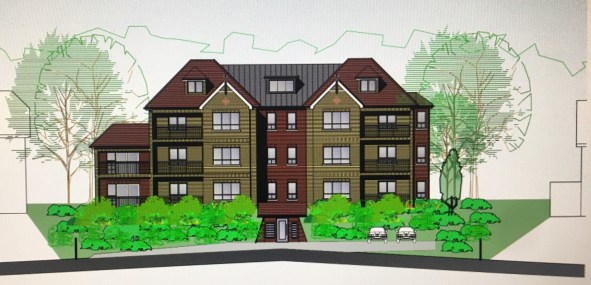
Big and ugly: will 88 Riddlesdown Road get past the committee, or will they notice that it doesn’t comply with council policy on family homes?
And the agenda for tonight’s planning meeting provides them with ample opportunity to do just that.
We have the usual lack of information within applications and the excessive “conditions” recommended to be attached to any permissions granted. We have the inadequate on-site car parking and unacceptable impacts on adjoining owners. But perhaps the pick of the bunch on tonight’s agenda is buried within the returning scheme for 88 Riddlesdown Road and the issue of “unit size mix” and the council’s adopted policies on the need for “family homes”.
Only 9per cent of the dwellings proposed at 88 Riddlesdown by Mantle Developments Ltd are family-sized (three bedrooms or more). The council’s own policy says that in this location that figure should be a minimum 70per cent. And yet because a Planning Inspector has not expressly concluded that this is unacceptable in this case, officials are recommending that this should now be approved, potentially adding another 19 one- or two-bedroom flats to an already saturated market.
Coincidently, the number of family-sized units was also an issue in the appeal on 34 Arkwright Road. In that case, the scheme provided 58per cent (still not the 70per cent required), but was still not enough for that Inspector, or in the end for the council.
Having initially failed to list this as a reason for refusal, on October 6, the council’s planning department was forced finally to acknowledge that the scheme would be contrary to policy SP2.7 and DM1, as it failed to provide the 70per cent family homes.
Read more: Council delays and lack of enforcement cause residents misery
Read more: Director of planning’s bogus claim over Institute membership
Read more: Buyers beware: High Court judge puts planners in the dock
Read more: Objections? What objections? Opposition? What opposition?
- If you have a news story about life in or around Croydon, or want to publicise your residents’ association or business, or if you have a local event to promote, please email us with full details at inside.croydon@btinternet.com

- By having a comment section, we provide all readers with an immediate “right of reply” on all our content. Details of how this works can be read by clicking here
- Inside Croydon works together with the Bureau of Investigative Journalism, as well as BBC London News and ITV London
- Inside Croydon: 3.3million page views in 2021. Seen by 1.6million unique visitors in that 12-month period
