

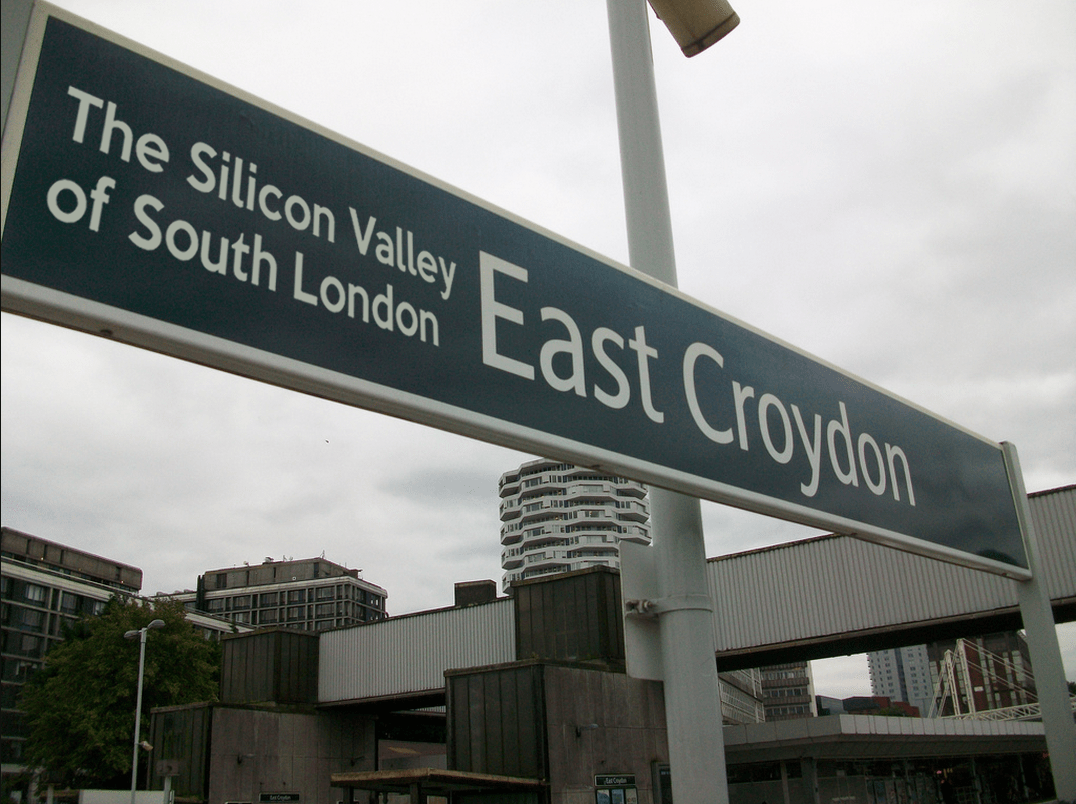
As property giants Hammerson and Westfield charge headlong into a £1billion battle for the rights to develop another temple to high street retailing, proud Purley resident JONNY ROSE puts forward an alternative vision for regeneration: the Silicon Valley of South London
The unwelcome news last week that Allders of Croydon is closing comes after a line of other long-established businesses are preparing to flee the borough.
Surprisingly, the council and local government remain in thrall to major retail developers who are promising an economic and cultural Renaissance, if only they can build yet another soulless, identikit multi-storey shopping centre.
These retail developers are well aware of consumer shift from in-store shopping to online purchasing, but those in charge of the 2012-2013 “masterplan” for central Croydon will have long moved on, often perhaps with a golden handshake, when the borough is left with its empty and echoing “McMall” by the next decade.
Perhaps, then, it is time for those in charge of stewarding the borough’s fortunes to look to an area of the economy which is seeing promising growth: tech start-ups.
It’s time for Croydon to start again.
A tech start-up has many definitions but most simply is “a new business that is building a technical product”.

As high street retailers struggle, with stores such as Allders closing, new tech products and services are being launched, such as the iPhone5 this week and yesterday’s announcement of a 4G network. Where is Croydon positioned to move in on these 21st century businesses?
What it looks like a small group of excited coders working together to create something (perhaps a piece of computer software, a mobile application, a website business – the possibilities are, for now, endless) could potentially be profitable in the near future.
Across the country, councils are swarming to support a burgeoning confidence in the digital start-up sector. And why shouldn’t they?
The rest of the world has been capitalising on this wave of entrepreneurialism for the last five years as university leavers and more seasoned workers pursue an entrepreneurial urge to start their own businesses and build life-changing digital products.
The economic benefits of cultivating a start-up economy are myriad. Israel’s economy has been resuscitated by having what is claimed to have “the largest density of tech start-ups in the world”, according to Dan Senor, the co-author of Start-Up Nation: The Story of Israel’s Economic Miracle.
The nature of a tech start-up lends itself well to a cash-strapped borough such as Croydon. Nearly all start-ups are self-financed by their founders as they build their first digital products by “boot-strapping” until an investor is ready to lend money or the product is profitable in and of itself.
And where start-ups are, the money soon follows as venture capitalists scramble to finance the next Google, Facebook or PayPal. This tends to create a vibrant micro-economy of focused entrepreneurs, developers and investors. The response is a whole host of cultural and commercial offerings that rise up to meet the demands of these groups – art festivals, concerts, niche restaurants, collaborative workspaces and so forth.
Croydon as a home to start-ups in not hard to envision – just look at what’s been happening around Old Street and Shoreditch for the last six years.
Slowly but surely, the area has morphed from a bland concrete jungle to a hub of innovation to be reckoned with – home to more than 400 tech start-ups. In 2010, the government took notice of this particularly localised tech cluster and rebranded it “Tech City“. This has led to further investment in the area.
Croydon has all of the potential to emulate Tech City’s success and become a credible player on the European tech scene.
First, Croydon is already a formidable tech cluster of more than 600 digital, technical and creative businesses. The talent is here, it just needs to be consolidated.
Fairfield Halls showed in 2010 that it could draw 1,800 Drupal delegates to the area. As the council looks to invest more of public’s money into the venue, it would do well to encourage its potential as a conference venue for software companies and users.
Matthews Yard is a cafe and workspace established earlier this year that is attracting a strong following amongst Croydon’s musos, creatives and thinkers. It has everything in place to emulate the successes of TechHub – the popular Tech City workspace that births many of the areas best start-ups.
Old Town is slowly developing the chic atmosphere beloved of the hip developer types, and if you don’t look too closely, London Road has potential to have all the multi-cultural cool of Brick Lane.
The transport links from East Croydon to London terminals are – as many commuter will attest – often faster than travelling across London within Zone 1. East Croydon is also impeccably placed for those who want to escape the city for Brighton (another tech hub), Gatwick or the greener, more affluent areas of Surrey.
Most importantly, office space costs – which were already competitive – will be increasingly attractive to London companies which are feeling the rise in office space costs since Tech City’s rise to prominence.
(I explore these and many more reasons in my post here)
Who wants to be another Bluewater, when we can be a new Silicon Valley?
I am not entirely against Croydon developing a stronger retail core, however a new John Lewis will not:
- Renew our flagging arts and culture provision
- Help our elderly
- Connect the lonely
- Attract talent from around the world
- Teach our NEETs, those not in education, employment or training
- Prepare our young for the future

Jonny Rose: retail is not the only answer for regeneration
Tech start-ups may not be the great panacea to end all of Croydon’s woes but they will go a long way to improve our borough in a way that trying to regain the dubious honour of being one of “Britain’s Top 10 Retail Destinations” never will.
- Jonny Rose calls himself “the product evangelist” for the customer engagement platform Idio and runs social media courses for communities throughout the borough.
- On Thursday October 4, at Matthews Yard from 8pm he will be discussing and outlining his plans for Croydon Tech City. All interested parties are welcome to come and participate. For more information contact jonnyrose1@gmail.com
- Inside Croydon: For comment and analysis about Croydon, from inside Croydon
- Post your comments on this article below. If you have a news story about life in or around Croydon, a residents’ or business association or local event, please email us with full details at inside.croydon@btinternet.com
Related articles
- Westfield swoops in early with planning application for Croydon (insidecroydon.com)
- Library campaign invokes Lord Denning in official complaint (insidecroydon.com)
- United we stand: looking for a more representative Croydon (insidecroydon.com)