

CROYDON COMMENTARY: Long gone are the days when the Fairfield Halls could attract some of the biggest acts in the world, such as the Rolling Stones or the Beatles, says DAVID CALLAM. These days, the only beetles at the arts venue are deathwatch

Fairfield Halls has a lacklustre programme in the next two months
Fairfield Halls has passed its use-by date and we are allowing sentimentality and the usual lack of municipal leadership to coax us into throwing good money after bad.
A glance through the February and March diary shows how difficult the Fairfield Halls is finding it to attract star names. It also shows the depressing number of days on which this once vibrant arts venue is now “dark”. As Inside Croydon noted in the past, the Fairfield programme these days sometimes look as if the 1980s, 1990s and 2000s never happened.
The future is all too easy to predict: the dilapidation will worsen as the gap between income and expenditure widens until Croydon Council is forced to withdraw public subsidy and Fairfield goes the way of the Warehouse Theatre.
Like so many people I have happy memories of time spent at Fairfield; my first visit was as a soon-to-be secondary pupil impressed that my new school could hold its annual prize-giving in such grand surroundings.

There was a time when the line-ups at the Fairfields were the height of entertainment. The Beatles played the new Croydon venue twice in 1963
My fondest memory is watching my young sons chortling at a Chuckle Brothers performance in the Ashcroft Theatre; my most magical moment is seeing and hearing Nigel Kennedy fiddle his way up and down the aisles of the concert hall. I have been a patron over almost the whole 50 years of the Fairfield’s existence, but I won’t allow that to blind me to reality: circumstances have overtaken the place in a way that nobody could have predicted.
It’s inconceivable that today’s big names would play as small a venue as Fairfield – less than 2,000 seats – but 1960s idols, the Beatles, Cliff Richard and the Rolling Stones did. They were the money-spinners who subsidised less commercial acts.
For many years classical music fans could smile smugly as they took their seats, knowing they would enjoy a far better acoustic than those who attended concerts at Fairfield’s bigger sister, the Royal Festival Hall.
Recent refurbishment of the Thames-side venue has put an end to that distinction and last year’s addition of a second entrance to Blackfriars station on this side of the river makes the whole South Bank arts complex – three concert venues, the National Theatre, an art gallery and an IMax cinema – much easier to reach from Croydon.
When Fairfield opened in 1962, the O2 didn’t exist, nor did the Jubilee Line that connects it so quickly to Croydon via London Bridge. As for Wembley Arena, at the other end of the Junilee line, that was still the ageing and unlovely Empire Pool.
Fifty years ago, the Churchill Theatre in neighbouring Bromley didn’t exist either, while Wimbledon Theatre was a draughty Edwardian monument to the days of variety. Both are now fierce rivals for the attention of theatre-goers in Croydon, offering pre- and post-West End productions that Croydon’s Ashcroft Theatre can rarely match; since the advent of the tram, Wimbledon is more easily accessible, too.
Home entertainment in 1962 consisted of just two television channels, both broadcasting in black and white. BBC2 didn’t arrive until 1964, with colour programmes following three years later. And video was unheard of outside professional recording circles.
We had just three radio stations, the Home Service, the Light Programme and the Third Programme – four if you include the intermittent Radio Luxembourg.
The market has changed completely in the past half-century and Fairfield – the building, not the team who run it – is too inflexible. Anyone who has watched staff struggle in vain to compensate for the building’s shortcomings during a less formal show or an exhibition will appreciate my point.
We need a building that suits the entertainment and exhibition market; a building we can adapt easily to meet future needs. But what precisely is that market in Croydon? Do lovers of music, whatever the genre, want a concert hall in Croydon, or would they rather go further afield where they have a wider choice of favourite artists?
Do play-goers want a theatre of Ashcroft proportions? Would they perhaps prefer a performance space the size of the Warehouse? Or do they want both, and if so, are there enough of them to put bums on seats throughout the year?
Do audiences want to watch art-house movies in the vastness of a concert hall or would they prefer somewhere of similar proportions to the David Lean Cinema at Croydon Clocktower?
Do we expect our entertainment venues to pay their way, or are we happy to subsidise them, even if that may mean unwelcome increases in taxation? Is a major arts complex a must-have accessory as a status symbol?
I have my own thoughts, but no idea of the general view. And I don’t think Croydon Council has either. It glibly spends our money to prop up the status quo, when it should be considering as wide a cross-section of alternatives as possible.
In a recent written exchange with Councillor Tim Pollard, he tells me he receives more letters in favour of subsidising the Fairfield than of stopping it. That’s not a good enough reason to spend increasing amounts of public money.
We need independent research to determine exactly what the market will support. Assuming we want a major arts complex in Croydon – and I hope we do – I imagine it will be a flexible building able to offer performance spaces of widely differing sizes and varying degrees of formality.
If so, we need a developer and operator who will build and run it without subsidy. Indeed, I expect there to be profits and I think the people of Croydon should share them, which would help to keep council tax lower than it might otherwise be.
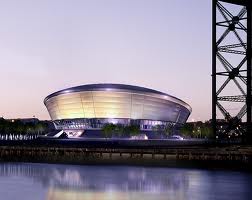
Glasgow’s new venue, the Hydro. Croydon has the Fairfield Halls
I have no wish to anticipate the outcome of such research any further, but I do think we need to be bold in our response.
Let me offer an example of what I mean by boldness: at the time we were arguing about a possible 12,000-seat arena in central Croydon, Glasgow decided to go ahead with a very similar project.
The city’s new arena, The Hydro (naming rights sold to Scottish Hydro, an electricity company), opens in September. Acts booked for the final quarter of 2013 include Andrea Bocelli, Peter Gabriel, Mickey Flanagan and JLS. As an example of its “flexibility”, in 2014, it will stage netball and gymnastics at the Commonwealth Games.
Developer, Scottish Exhibition & Conference Centre Limited, expects the new venue to contribute £130 million annually to the local economy and to create 1,400 jobs.
- Inside Croydon: For comment and analysis about Croydon, from inside Croydon
- Post your comments on this article below. If you have a news story about life in or around Croydon, a residents’ or business association or local event, please email us with full details at inside.croydon@btinternet.com
Related articles
- Getting trollied: Croydon’s uncharitable councillors (insidecroydon.com)
- Legacy of the riots: Croydon abandoned by middle-class (standard.co.uk)