


That means that the death rate in Britain is the highest in Europe and one of the highest per capita death rates in the world. The covid death toll is more British civilians than died in both world wars combined.
And then Prime Minister Boris Johnson told the nation last night, “We truly did everything we could to minimise the loss of life.”
Which is clearly and demonstrably untrue.
The Prime Minister’s statement was the cause of justifiable anger, and not only among those for whom the 100,000 figure is more than a statistic but represents something which has bitterly changed their lives forever, after the loss off a partner, husband or wife, a mother or father, grandparent or child.
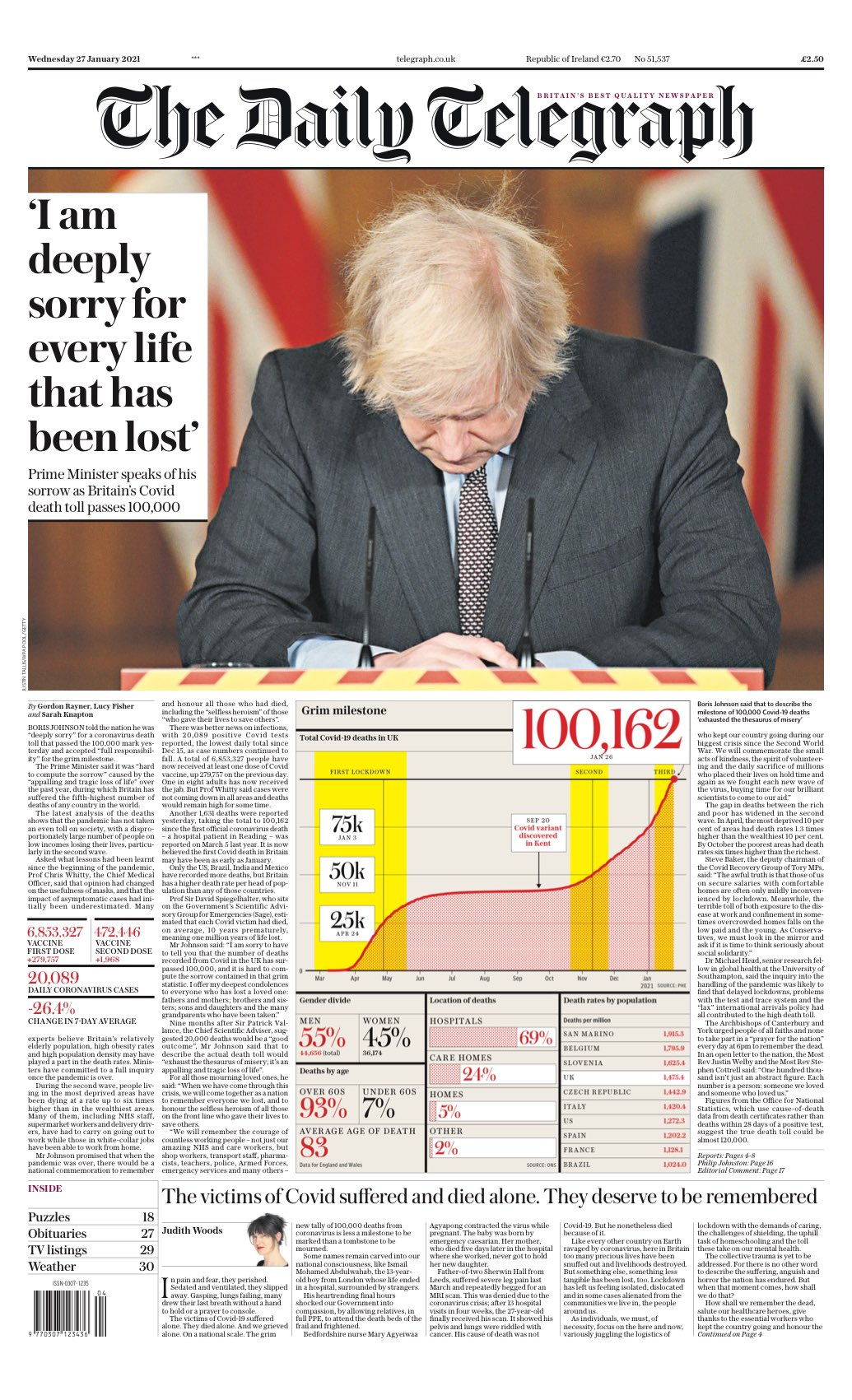
How the Tories’ client press reported the Prime Minister’s latest apology
The figures, which go up to January 15, are based on death certificates. The government’s daily figures, which rely on positive tests, are slightly lower.
It follows a surge of cases in the past month, after Johnson and his Government “argued” with scientists over whether to quarantine the country again with a lockdown, or to allow people to “enjoy” Christmas, or whether to allow schools to re-open in the New Year. Faced with a crucial decision at every turn to minimise the number of deaths, Johnson and his Government have almost always made the wrong choice.
Half of the deadly total of deaths has occurred since November 11, as the rate of infection, numbers of people hospitalised and the number of those dying from covid has soared.
Last March, Patrick Vallance, the chief scientific adviser, had said that limiting British deaths to 20,000 would be a “good outcome”. Then, people were rightly horrified at such a prospect.
On January 30 last year, the World Health Organization had declared covid-19 to be a “Public Health Emergency of International Concern”. Two months were to pass before Johnson and his Government imposed a lockdown.
“This error was compounded by other mistakes such as the despatch of large numbers of untested patients from hospitals to care homes, the abandonment of community testing on March 12 and the failure to mandate mask-wearing in shops until July 24,” an article in the latest edition of the New Statesman says.
“From the start of the pandemic – when there was time to prevent a catastrophe – the UK failed to grasp the seriousness of the threat. Mr Johnson treated covid-19 first with libertarian insouciance (boasting on March 3 that he ‘shook hands with everybody’ at a hospital) and then with indecision.”
The ending of the lockdown in the summer, getting people back into their offices and workplaces, and spending millions to get the public to “Eat Out to Help Out”, while leaving our borders open for summer holidays now appears to be the height of Governmental incompetence. When the new variant of covid-19 appeared, the government had helped create the conditions for it to thrive.

As some broadcast media last night tried to reflect, covid-19 is a cruel, often lonely way to die. But it is also a virus that has left its mark on those who have survived, many enduring “long covid”, with debilitating and enduring symptoms.
The third national lockdown – again imposed too late – has in the past days begun to reduce infection rates – certainly in Croydon.
The vaccination programme is being rolled out at pace and offers some hope, although again, this Government has opted to ignore the experts, dismiss the recommendations of WHO and the scientists who developed the vaccine, and instead of providing booster jabs after no more than six weeks, has decided to keep the vaccinated waiting for three months, as they spread the dosages more thinly among a larger number of people.
Across the whole of London,
12,677
have died as a result of coronavirus.
In Croydon, the death toll is approaching 700 people.
There has been a total of 632,735 positive cases of coronavirus in Greater London in the past year.
According to the latest available figures from coronavirus.data.gov.uk, as at yesterday’s date, there were 6,785 patients in London’s hospitals.
At Mayday in Croydon, admissions from coronavirus reached a peak of 250 patients a week ago.
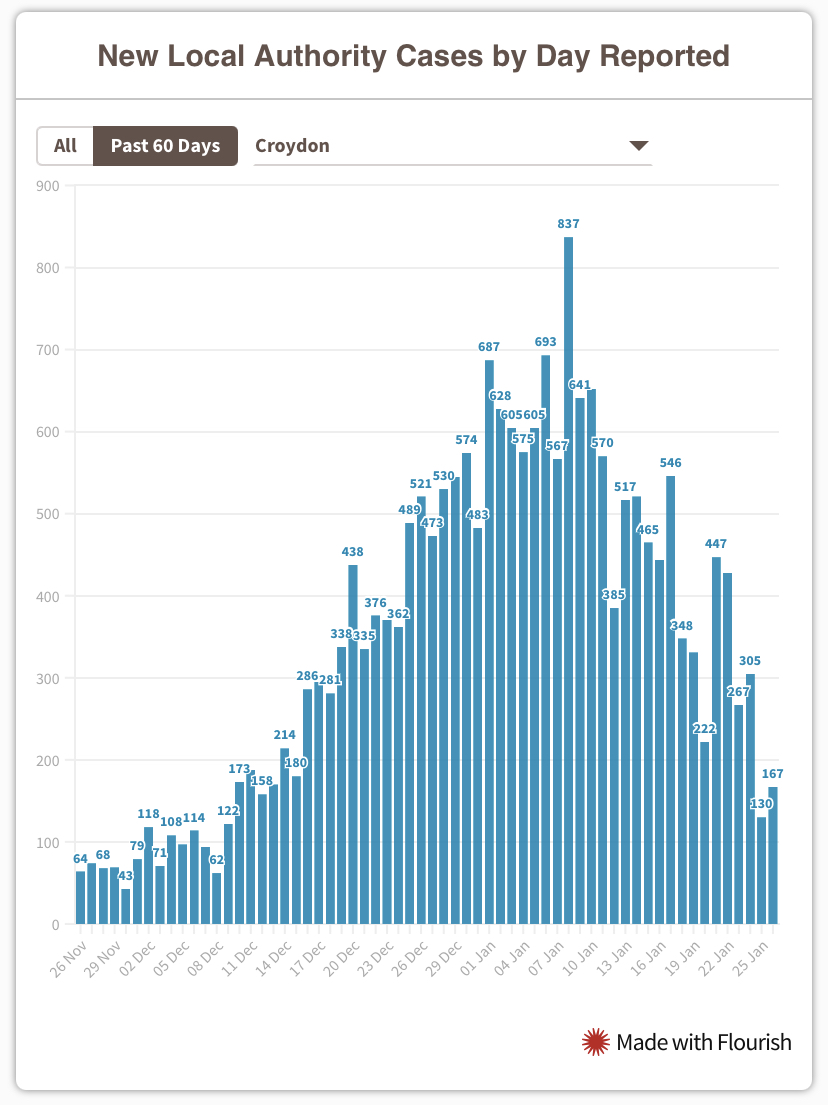
How the number of positive cases in Croydon appears, finally, to be reducing. Figures correct to Jan 26 2021
The hard-pressed NHS staff at the hospital are hoping that residents of the borough, and beyond, stay home and avoid unnecessary journeys or shopping trips, to reduce the chance of catching or spreading the virus.
On January 8, the number of positive cases in Croydon reached a troubling 837. Since then, the figures of positive cases has been falling, down to 130 by Monday, January 25 (though that number carries all the by-now familiar caveats about delayed reporting of figures over weekends), and 167 yesterday (Jan 26).
Perhaps, just perhaps, a corner has been turned.
But one thing the outpourings of justifiable anger at the latest horrific statistics might have done is remind us that every one of these 100,000 is a real person, a mother or father, son or daughter.
Dorothy Duffy’s sister, Rose, died in a nursing home in London on April 4 last year. She was 81, and died, alone and quarantined because she had coronavirus.
Dorothy said that all she could think of in the hours after Rose’s death was: “My sister is not a statistic.”
Her poem has since been broadcast and read widely. It might not have been read widely enough, though, and given the latest grim news, it seems a fitting memorial to the many thousands of victims of the terrible virus.


- If you have a news story about life in or around Croydon, or want to publicise your residents’ association or business, or if you have a local event to promote, please email us with full details at inside.croydon@btinternet.com

- Inside Croydon works together with the Bureau of Investigative Journalism and BBC London News
- Inside Croydon: 3million pages views in 2020, viewed by 1.4million unique visitors
