

By STEVEN DOWNES

“Dr” Alison Knight: mentioned in High Court case
“Dr” Alison Knight, the council’s £800 per day interim director of housing, who was recruited in a rush by CEO Katherine Kerswell to deal with the Regina Road council flats scandal, might want to have a quiet word in her colleagues’ shell-likes about any misconceived attempts to use the courts to try to gag the media.
Knight recently got a not very favourable mention in a landmark High Court ruling that found in favour of a “frequently puerile” blogger in the Midlands.
And now Knight’s former employers at Sandwell Metropolitan Borough Council have been forced to cough up at least £50,000 in legal costs to Jules Saunders, the retired solicitor who runs the Sandwell Skidder website.
The court action against Saunders and the Skidder was brought by one of Knight’s old colleagues at Sandwell council, Lisa McNally. Or “Dr” Lisa McNally, as she has tended to be referred to.
Knight, who joined Croydon Council in May, is understood to have added her own complaint about the coverage of her time at Sandwell by the Skidder, though she never provided a statement as evidence for the court case.

Lisa McNally: used harassment law, rather than libel, to try to gag blogger
McNally, Sandwell council’s director of public health, brought her case under the Protection from Harassment Act 1997, seeking an emergency injunction with a penal notice that could have seen Saunders behind bars if he had gone within 50 metres of the council official – who the blogger says he has never even met.
McNally’s claim even suggested that Saunders, the man she has never met, posed a physical threat to her.
But the judge threw the case out.
In his judgment, Mr Justice Chamberlain said that Saunders “says that the blog is ‘directed at exposing corruption, cronyism and incompetence’ at the council”, and that he seeks to emulate Private Eye.
“Whether he succeeds in that aim,” the judge said, “is another matter.”
McNally had complained about five posts published on the Skidder which criticised her decision to post a video about her own struggle with poor mental health. Saunders also questioned her use of the title “Dr”. Sandwell’s director of public health is not medically qualified. She is a psychologist by training.
Interestingly, Knight has also tended to style herself as “Dr”, even though she has no medical qualifications. Croydon Council, in announcing her appointment earlier this year, referred to her as “Dr Alison Knight”; her qualification is not in any discipline relevant to her work. Knight’s doctorate is in education.

Is there a doctor in the house?: Croydon Council’s announcement of the appointment of Knight styled her as a “Dr”. In fact, Knight has no medical qualifications
In his submission to court, Saunders explained his reasons for publicly reporting on McNally’s use of the title “Dr”: “The General Medical Council (GMC) say quite clearly to me that even someone with a medicine-related PhD must not hold themselves out as being a practising medical practitioner if s/he is unregistered (indeed it is actually a criminal offence)…
McNally “passively allows people to form their own conclusion – and most people are seemingly coming to the wrong one”, Saunders wrote.
“Why might this be relevant?” the blogger asked.
“Well, our Lisa McNally has frequently put up on social media articles from the likes of The Guardian knocking the government response to Covid. Without wishing to denigrate the excellent and important work of chartered psychologists, she is hardly in the same league as the likes of Professors Whitty and Vallance and it is important at this critical time that the public do not get the impression that she is a high-level medical expert. The public need to understand the limits of her medical knowledge and that she is specifically not a medical doctor.”
This coverage in the Skidder stemmed from a video which McNally had made about her own mental health issues in May 2020, and which remained published on Sandwell council’s own Facebook page more than a year later, even as McNally’s case went to court.

Mentioned in evidence: Alison Knight got a name check in the High Court case, though she submitted no statement about her complaints about the Sandwell Skidder
In her evidence, McNally claimed the coverage in the Skidder caused her “crippling” anxiety and made her worry about her ability to do her job. Her QC claimed that Saunders, as “an unregulated lone blogger”, is not entitled to be treated as a journalist.
This lawyer’s claim neatly sidestepped the simple fact that all publishers in this country, including the Sandwell Skidder, are indeed regulated, by the law, including libel. But council officials, and councillors, are legally prevented from using local authority resources to fund libel cases (under The Local Authorities (Indemnities for Members and Officers) Order 2004, article 6 (3), since you ask).
And since 1993, it has been the law that local authorities are not allowed to sue for defamation. After all, they rarely have a reputation that is worth defending…
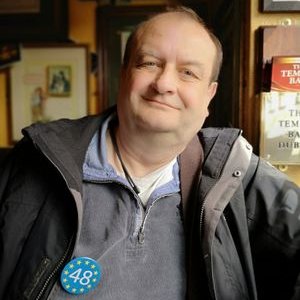
Jules Saunders: his council has to pay him at least £50,000 in legal costs
But by pursuing a harassment case and not suing for any alleged libel, it seems, McNally hoped to get around those restrictions. A spokesperson for the council has confirmed in the past week that the local authority paid for McNally to bring the harassment case against Saunders, meaning that the highly paid council executive at the centre of the case won’t have to dip into their own pocket to fund the costs, but has instead got the hard-pressed Council Tax-payers of Sandwell to pick up the tab.
In his judgement, Mr Justice Chamberlain was clearly not a fan of Saunders’ writing style, but he was clear on his legal rights to report on matters of genuine public interest involving often highly paid public servants working at the council.
Given the Skidder’s “frequently puerile tone and style, a casual reader… might be surprised to discover that they are the work of a semi-retired former solicitor”, the judge noted.
However “none of these features disentitles them to the protections afforded by the law to journalistic expression”.
The judge said that McNally herself had chosen to place the information about her mental health issues in the public domain. “Someone who decides to make a public disclosure of this kind must expect that, while many people are likely to comment favourably, some may choose to make comments that are adverse.”
Granting summary judgement to the blogger, the judge ruled that the public interest in McNally being able to continue in her role was outweighed by Saunders’ Article 10 right to free expression.
Saunders’ “abrasive tone and style did not disentitle them to that protection”, the judge said.
Read more: Commissioner orders council to answer FoI over libel threats
Read more: Newman fails to gag website over councillor’s resignation
- If you have a news story about life in or around Croydon, or want to publicise your residents’ association or business, or if you have a local event to promote, please email us with full details at inside.croydon@btinternet.com

- Inside Croydon works together with the Bureau of Investigative Journalism, as well as BBC London News and ITV London
- ROTTEN BOROUGH AWARDS: Croydon was named the country’s rottenest borough in 2020 in the annual round-up of civic cock-ups in Private Eye magazine – the fourth successive year that Inside Croydon has been the source for such award-winning nominations
- Inside Croydon: 3million page views in 2020. Seen by 1.4million unique visitors
