


Two thousand people signed our petition asking for “money proposed for the Dingwall Road loop to be spent instead on longer trams and longer platforms to cope”. The petition was handed over to London Mayor Boris Johnson last week by London Assembly Member Caroline Pidgeon, the transport committee vice-chair at City Hall, on behalf of a cross-party group which had organised the petition.
This petition was signed by four times the number of people that responded to the Transport for London consultation.

Soon to be a scene from history, a tram crossing the Dingwall Road junction headed for Beckenham Junction
Our trams are crowded. We would agree with money spent on extra trams, dualled track or anything that actually adds capacity to the tram network.
But most of the £28 million cost of this loop is to move utility pipes out of the way of track, and would actually cut the tram system into two, instead of adding extra passenger capacity.
A large percentage – perhaps most – of the project’s budget is being spent on moving phone, gas, electricity and sewer service pipes out of the way, so that when BT or British Gas want to dig up the road, the tram services won’t be interrupted – even though they still interrupt the trams for plenty of other reasons, such as track replacement and “Connected Croydon” works.
Most importantly, services positioned under platforms would cause nothing like the same interruption to the trams if the utility providers need to replace them – especially if the platforms are lengthened by one metre, so the tram doors could be opened in places where the platform was not being dug up.
British Gas, BT and the other utility providers have a reputation for overcharging for the cost of moving their services, and that seems to be the case here, prompting some of us when seeing the costs being charged to wonder whether they are being provided with gold-plated pipes.
We are saying the £28 million cost of the Dingwall Road loop could be better spent, with about £8 million on longer platforms and £20 million spent on buying eight extra trams, which would enable 16 of the existing tram fleet to be coupled together – providing longer trams without loss of frequency of services. Extra trams could be stabled overnight at Wimbledon and on dualled track to Elmers End.

A sign of things to come…
Our group – which includes several transport and engineering professionals – have investigated TfL’s worries about the costs of longer platforms, and we have even got quotes from the spare parts department of tram manufacturers Bombardier about the cost of couplers. Longer platforms and trams are a better use of £28 million than a loop to nowhere.
Our group had a meeting with TfL at City Hall, where the officials conceded the need for longer trams. TfL’s director Sharon Thompson said so at that meeting and they also showed us drawings of how they were investigating how to lengthen trams – albeit to 43 metres long, made up of three cars. Those written studies prove also that they are seriously thinking about longer trams.
We then went away and sent back a response showing solutions to the coupler cost, straight platforms and the Old Town traffic junction issues they raised. We doubled our original cost estimate to £8 million to include those solutions. But TfL are only talking about longer trams in 2025, when the current trams “life expire”. We are saying the big need for increased capacity (the spike rise in their graph) will be earlier, in 2020 – when the Westfield shopping mall is due to open – so we need coupled trams sooner than life expiry.
There is also a compelling financial reason for ensuring that the £15 million provided by Westfield towards tram improvements is wisely spent, on increasing capacity, rather than those gold-plated utility pipes: with cuts in public spending likely to impact for a decade, this may be the only opportunity to get money to spend on longer trams.
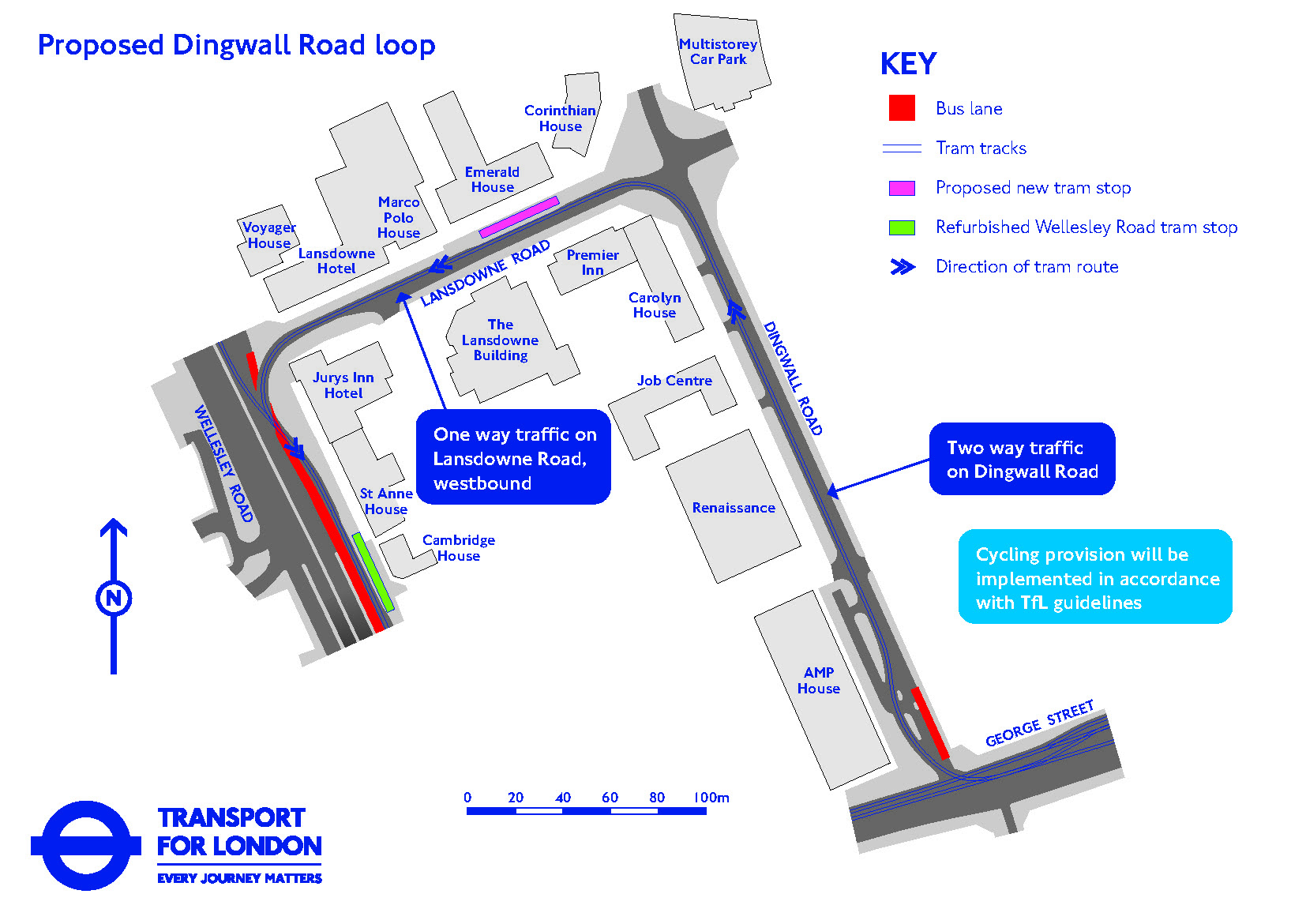
The Transport for London Dingwall loop which they intend to impose on the tram network, for the benefit of utility providers, rather than passengers
And there’s another reason why we need longer trams, rather than just more two-car trams operating on the network. Where we already have trams at five-minute intervals, we don’t need more frequency – we need longer trams. Trams are already bunching up on the Elmers End route – where rush hour trams are often held up because they are too overcrowded for the doors to be closed. Meanwhile an emptier tram catches up and unlike a bus, it cannot overtake.
Those two trams would be better run as one tram coupled together. Coupled trams double capacity while halving how many trams cross each of the 17 road junctions on the route. Longer trams thus hold up other traffic (like buses) less.
Our campaign has gone cross-party with meetings with Labour and UKIP supporters, too.
As the chair of Croydon’s Liberal Democrats, I am quite willing to take any politics out of this. I am just using any political connections I have to further this goal – of more capacity for our trams. Let’s join together for the same aim – and make sure that limited resources of public or Westfield money is focused on carrying more people to our shops, instead of just paying for pipes under a loop designed to curtail cross-town trams.
In the meantime, Wimbledon’s new platforms have just opened – but they are just too short for coupled trams. The Wimbledon design clearly predated TfL’s acceptance of the need for longer trams.
They are already playing catch-up with their own demand graph, talking of waiting until “life expiry” in 2025 before they buy longer trams – and even then talking of 50 per cent longer trams to cope with 100 per cent more people.
Our existing trams can be coupled together to provide 100 per cent more capacity where it is needed without causing extra traffic problems as they cross Wellesley Road or any other junction. Westfield shoppers are better served by that extra capacity, instead of wasting Westfield’s money paying service companies to move pipes out of the way of useless new bits of track on the Dingwall loop. If any trams need to turn around, it is at rush hours only – and the third platform at East Croydon is already used for that purpose. It could easily turn five trams an hour around, without spending £28 million.
-
Inside Croydon: Named among best regional media campaigns, 2014.
- Croydon’s only independent news source, based in the heart of the borough: 729,297 page views in 2014.
- If you have a news story about life in or around Croydon, a residents’ or business association or local event, please email us with full details at inside.croydon@btinternet.com