


It is not unknown for local residents’ associations to be heavily influenced by people whose idea of lifestyle, planning and architectural design Nirvana is a nice little Terry and June-style bungalow in a quiet cul de sac, with neighbours who keep themselves to themselves.

The bogeyman of “back garden developments” is used to frighten other residents, even if the ends of the back gardens are large and a long way from existing homes
I have seen in our area, and in nearby Tandridge and Reigate and Banstead, numerous well-designed “backland” developments, but also some really bad ones.
There is a good (no… I mean, really bad) example happening in Chipstead Valley Road, near where I live in Coulsdon, where a single new dwelling is being shoe-horned into the small space between the houses on the busy road and the adjacent street. It looks like a real imposition on the neighbours.

Target: this piece of an architect-designed estate near Coulsdon Court could make way for five terraced houses
Other examples, involving local-based developers who have become notorious for their close relationship with the council’s planning department, have also been reported on the pages of this website.
Good examples, however, can make very good use of land, creating decent homes where existing back gardens are huge, and sometimes hardly used or even semi-derelict.
The main alternative to this kind of intensification is building on the Green Belt. We do need enough industrial and commercial land to provide local jobs and to service Croydon and a fair share of the needs of wider London, so enough land of this kind needs to be kept– in the right places– and not all residentialised.
Looking at the Green Belt in Surrey, there are places, like Lingfield, which are bizarrely designated as Green Belt but are clearly suburban in nature, not countryside. They have big areas of small(ish) houses on enormous plots. If these were redeveloped, at a higher density, the local village would be more viable, able to support public transport links, and secure the future of shops, schools and pubs. Thriving even, with cappuccino outlets, tapas bars, nail bars and all the hallmarks of modern post-Brexit, post-covid (I hope) Britain.
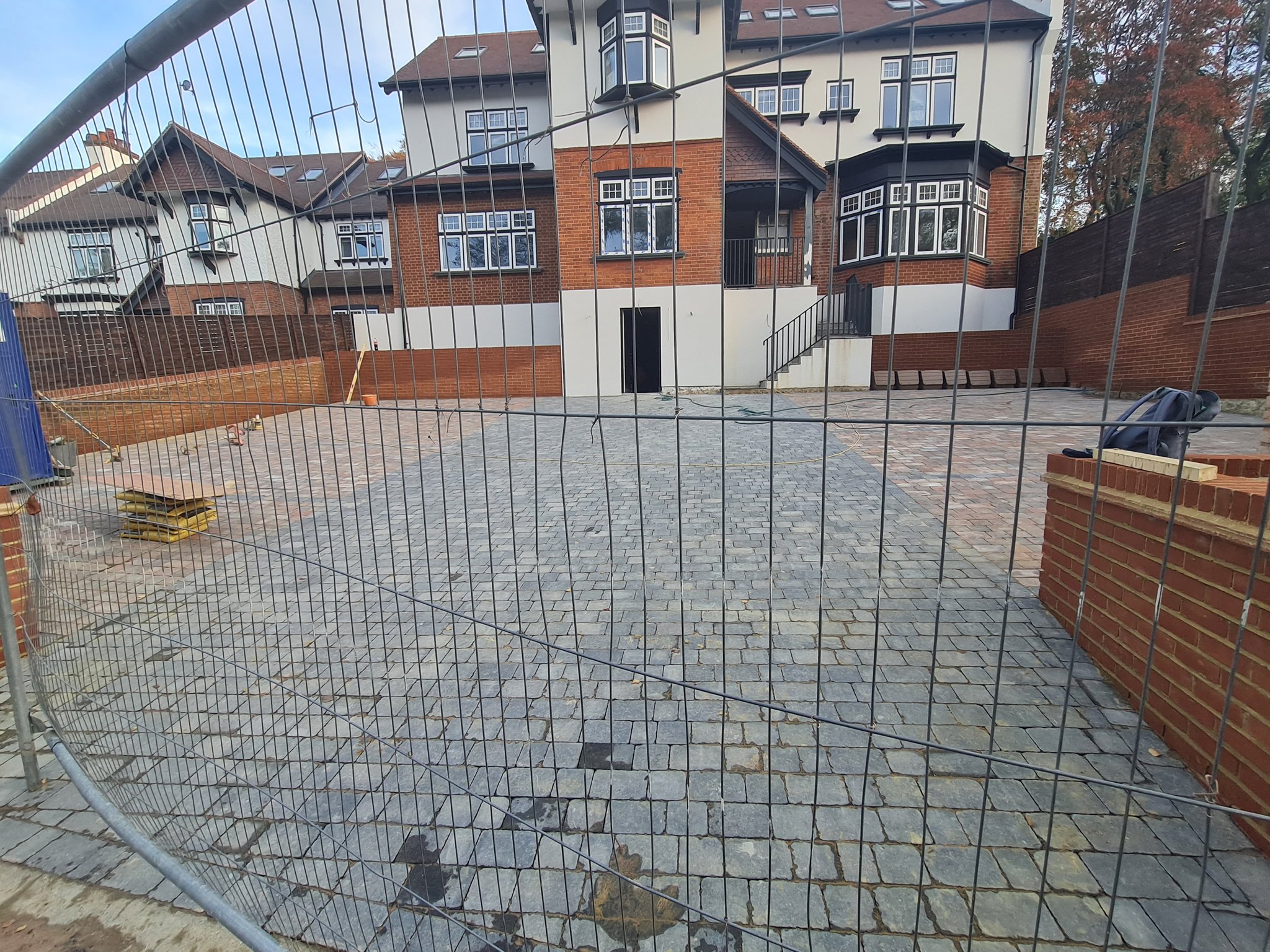
Car park hell: too many blocks of nine flats have been allowed with ugly design and wasted parking space
There are still many suitable plots for “intensification”, but there are also sites where far too much development has been crammed in, resulting in frontages that are all paved for parking, maybe with a pathetic shred of designed greenery, like car-bay edging hedges which often get wiped out by cars driving over narrow and unprotected shrub beds.
Intrusive night-time lighting on such car-dominated street frontages with uplighters, downlighters and unshielded lights to mark the driveway entrances and access steps is also a growing problem that needs to be controlled before we are all dazzled when we are passing by, and sleep-deprived if we live nearby.
Inside Croydon has run several articles spotlighting monster builds clearly far too large and well out of scale with the host street and general neighbourhood.
The more intensive the design density, and the closer the development gets towards developing from one end of the frontage to the other, the less the space for trees, shrubs and grass.
With the usual concerns about Nimbys and NAAE (Not Anything Anywhere Ever) and other variations, I wish OCRA well with their campaign, and hope that their survey comes to some clear and intelligent conclusions.
Read more: Old Coulsdon village to fight against planning ‘intensification’
- Lewis White is a retired landscape architect, with decades of experience working for local authorities in south London. He lives in Coulsdon
Croydon Commentary is a platform for all our readers to offer their personal views about what matters to them in and around the borough. To submit an article for publication, just email us at inside.croydon@btinternet.com, or post your comment to an Inside Croydon article that has caught your attention
- If you have a news story about life in or around Croydon, or want to publicise your residents’ association or business, or if you have a local event to promote, please email us with full details at inside.croydon@btinternet.com

- Inside Croydon works together with the Bureau of Investigative Journalism, as well as BBC London News and ITV London
- ROTTEN BOROUGH AWARDS: Croydon was named the country’s rottenest borough in 2020 in the annual round-up of civic cock-ups in Private Eye magazine – the fourth successive year that Inside Croydon has been the source for such award-winning nominations
- Inside Croydon: 3million page views in 2020. Seen by 1.4million unique visitors
