

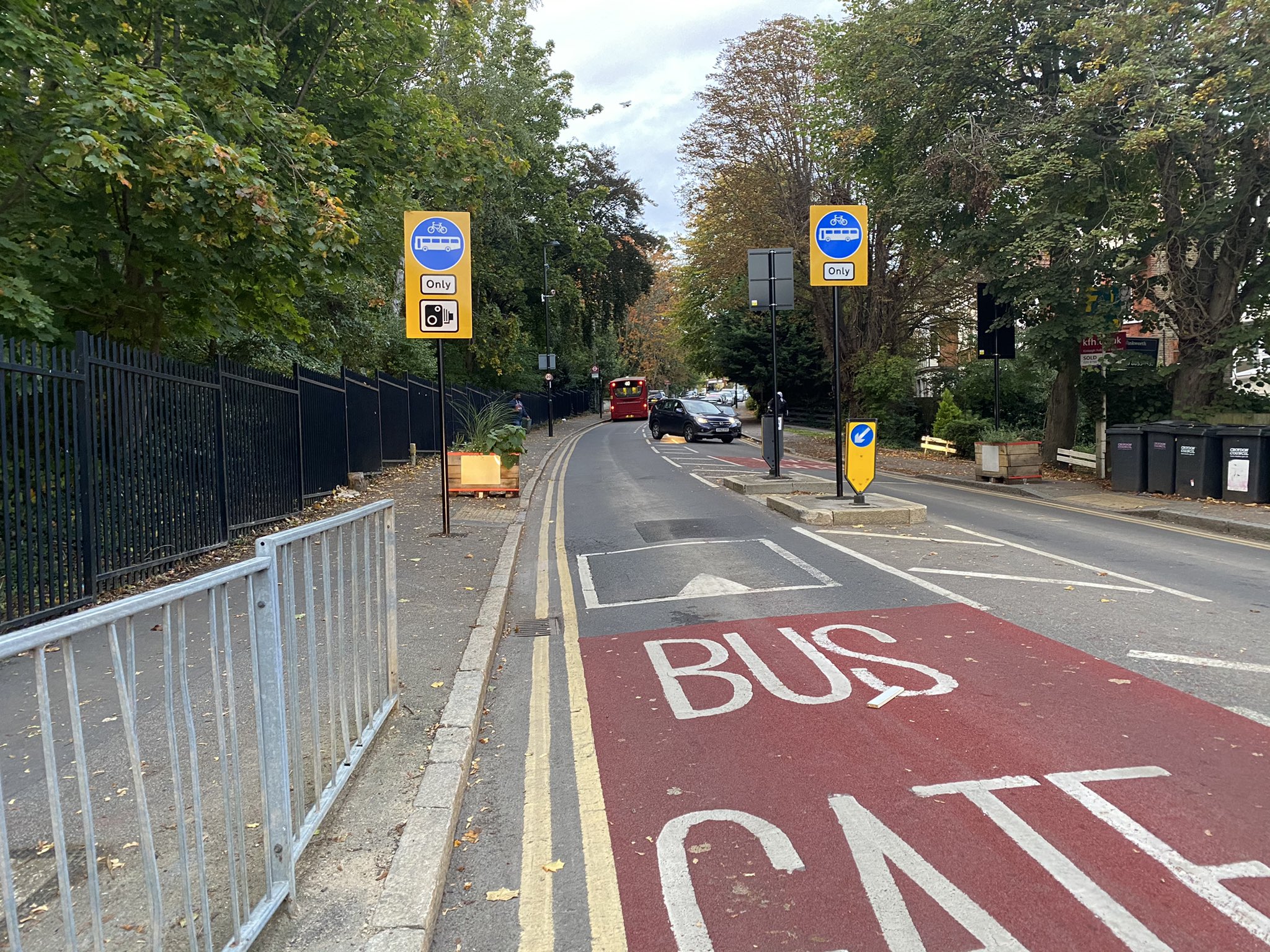
The disliked bus gate on Auckland Road will continue, but will be repositioned
As traffic U-turns goes, Croydon’s latest has the look of a screeching handbrake turn.
The Low Traffic Neighbourhoods in Crystal Palace and South Norwood are no more. In their place is a not-too-subtly rebranded “healthy streets scheme”.
Gone are the wooden planters which caused the gammons of Bromley to go even more red in the face than usual, to be replaced with CCTV cameras to monitor the comings and goings on five residential streets.
After a badly bungled implementation, with poor public outreach last year, the council climbdown has been gradual and painful, and the recriminations often bitter and divisive, but what has been announced today from Fisher’s Folly promises “a balanced approach”, a trial over at least 12 months and, importantly, the prospect of monitoring of traffic volumes and air quality.
Both latter aspects were notably missing from the rushed preparation work before the LTNs were introduced last year, as emergency measures during the first lockdown, leaving Muhammad Ali, the cabinet member for unsustainable Croydon, much undermined when it came to trying to win an argument against car use with those locals who took against the barricades in a south London form of road rage.

There’s growing evidence that LTNs have worked to reduce traffic and air pollution
The new measures – using ring-fenced money from Transport for London and the Tory government – are due to be introduced from March 4, though Ali’s decision was immediately called in to scrutiny last night by Labour ward councillor Stephen Mann and the opportunistic Tory opposition.
A council statement today described the measures signed off by Ali as, “A new walking and cycling initiative is set to make Crystal Palace streets safer quieter and healthier.”
They will see ANPR – automatic number-plate recognition – cameras installed at five locations across Crystal Palace and South Norwood:
- Sylvan Hill at the common boundary of Nos 11 and 13
- Lancaster Road junction with Goat House Bridge
- Fox Hill junction with Braybrooke Gardens
- Stambourne Way junction with Auckland Road
- Bus gate introduced at the common boundary of Nos 86 and 84a (Auckland Road Surgery) Auckland Road
The council said, “The healthy streets scheme will replace the previous Low Traffic Neighbourhood and addresses concerns raised by residents and businesses who were consulted by the council at the end of last year.”
By using cameras – which can generate 60-quid-a-time fines for anyone without a pass or exemption – the council argues that the measures will give better access to emergency vehicles and local residents. A bus gate on Auckland Road will be re-positioned, to ease access to a surgery on that road.
“Exempt motorists include registered car clubs, taxis, emergency vehicles, local teachers and carers who will be able to drive through the partial closures, as well as residents within the LTN boundary,” the council said.

Road rage: Muhammad Ali has altered council position
The decision “is now subject to further discussions with neighbouring boroughs to make sure it is suitable for residents of both boroughs”, Croydon said – meaning that Tory-controlled Bromley have been a thorough-going pain in the arse over the whole matter, and no one expects them to accept even the revised scheme.
The council said, “Streets will remain open in all directions until an agreement has been reached.” Given Bromley’s implacable opposition to anything which might inconvenience the motoring lobbyists and road hauliers, that could be a very long time.
“In this time, air quality and traffic monitoring are expected to take place.” Note that: “expected to” – which suggests that such monitoring work lies outside the remit of TfL grants for LTNs, and given Croydon is skint, might not take place.
In the council statement today, they said, “The scheme will be implemented under a temporary ‘experimental’ traffic order and a report will come back to the committee after 12 months. During that time there would be an opportunity for local residents to provide their feedback via a survey available for anyone interested.” The council’s previous consultation was criticised for being allowed to be hijacked by vested interests and lobby groups from across the country.
“Traffic studies will take place before the scheme goes in, and while it is running through the experimental period. At the same time, air quality monitoring will be done to continually measure pollution levels.”
Muhammad Ali, who inherited the messy controversy when he took over the cabinet role in October, said today, “This is a balanced approach that allows us to reach our goal of encouraging more walking and cycling, making streets safer and reducing the number of unnecessary car journeys in this neighbourhood. At the same time we are improving access for more local residents, emergency vehicles, and those making essential car trips.
“I look forward to working with Bromley to develop our plans further, and collaborate on our shared goal of safer, healthier streets for all members of our community.”
Read more: Confused councillor in roads row after he ‘likes’ vandalism
Read more: Removal of LTNs was unnecessary says cycling campaign
Read more: The next battle in the culture wars? Traffic bollards
Read more: London’s toxic air is ‘a public health emergency’ says charity
- If you have a news story about life in or around Croydon, or want to publicise your residents’ association or business, or if you have a local event to promote, please email us with full details at inside.croydon@btinternet.com

- Inside Croydon works together with the Bureau of Investigative Journalism and BBC London News
- Inside Croydon: 3million pages views in 2020, viewed by 1.4million unique visitors
