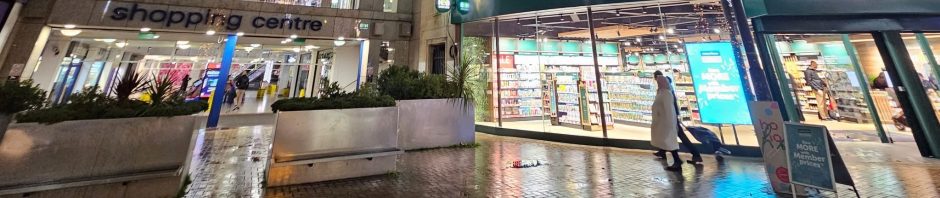
CROYDON IN CRISIS: A national homelessness charity has joined 30 local voluntary sector organisations in opposition to the cash-strapped council’s decision to close the public service area in Fisher’s Folly. The High Court legal case began today. By STEVEN DOWNES
 Croydon Council was dragged back before a High Court judge this morning, over the latest claims that under Tory Mayor Jason Perry it has conducted itself unlawfully and failed to fulfil its statutory duties.
A year-long battle to bring Croydon Council to account over its closure of its Access Croydon homelessness service reached the Royal Courts of Justice in the Strand this morning.
A Croydon resident, described as “vulnerable” and who has chosen to maintain their anonymity, has brought a Judicial Review against the council over the decision to close its walk-in homelessness service.
They argue that it discriminates against digitally excluded people and unlawfully restricts access to assistance.
Homelessness charity Shelter has joined the legal challenge, while the resident is being represented by lawyers from the Public Interest Law Centre (PILC).
Proceedings began this morning, and are expected to last two days.
The case is being heard by Judge Alan Bates.
Croydon closed Access Croydon, the purpose-built public meeting space in Fisher’s Folly, in March 2025.

Purpose-built: Access Croydon was designed to allow the public to access council services. Mayor Perry ordered it close
Since the council closed Access Croydon abruptly, residents can only access homelessness information, advice or assistance via a system based on pre-booked appointments and an online self-service tool.
According to their lawyers, the claimant is an individual who faced eviction but, because of a learning disability, was unable to access Croydon’s “digital first” system.
The High Court granted permission for the Judicial Review in July, finding that a claim based on a breach of the Housing Act 1988, Human Rights Act 1998 and Equality Act 2010 should be heard. Shelter has since joined the challenge as a third-party intervener, providing evidence which supports the claim.
Acccording to PILC, “The legal challenge argues that Croydon Council acted unlawfully for several reasons: 1) it failed to meet its legal duties to homeless people; 2) it discriminated against people who cannot access digital services; 3) the decision to close Access Croydon was unconstitutionally made in a closed meeting without a written decision.”
That latter reason might chime as familiar with the way the council was criticised for its procedures under Labour leader Tony Newman and chief exec Jo Negrini. But this time the decision was taken by Tory Mayor Jason Perry and his CEO Katherine Kerswell.
“The changes to Access Croydon are part of the council’s action to protect local services for residents,” Kerswell claimed, disingenuously, at the time.
Almost 30 voluntary and charity sector organisations working in the borough wrote to Mayor Perry and CEO Kerswell demanding an immediate re-opening of the council offices to the public. They said that the council’s decision to close Access Croydon to anyone who does not have a pre-booked appointment is “denying residents access to vital support”.
Among the signatories were the Croydon BME Forum, Croydon Nightwatch, the London Renters Union, the South Norwood Community Kitchen, the South West London Law Centre and Croydon Voluntary Action.
Today, PILC said, “This hearing is a crucial opportunity to take seriously the concerns of vulnerable groups, including people with disabilities who cannot navigate online systems and rough sleepers without reliable internet access.”
Research by King’s College has found that the closure of face-to-face drop-in services for people experiencing homelessness has led to increased pressure on charities, frontline advice organisations and libraries providing digital support, as with Central Library in Croydon.
In some cases, hospitals are left supporting people unable to access housing services.
PILC solicitor Alexandra Goldenberg said, “We’re arguing that Croydon Council’s decision to close its walk-in services has created discriminatory barriers to accessing this vital support.

Clarity: Labour councillor Stuart King awaits the outcome of the court case
“Homelessness services exist to assist people in some of the most desperate and vulnerable circumstances. By closing its walk-in service, the council risks cutting off access to essential support for people who are digitally excluded or unable to access online or telephone services due to disability.”
Councillor Stuart King, the leader of the Labour group at the Town Hall, told Inside Croydon that the concerns contained within the Judicial Review had been raised by Labour councillors at the time the decision was taken by Mayor Perry.
“Nobody facing the prospect of homelessness should have to navigate an online system they cannot access in order to get help from our council,” Councillor King said.
“We hope the court will provide clarity on the legal responsibilities involved. In the meantime, Mayor Perry should reflect seriously on whether his current arrangements provide a genuinely accessible route to support for every resident facing homelessness.”
Read more: No Access Croydon: 30 voluntary groups demand reopening
Read more: They voted to raise your Council Tax, then to increase their pay

PAID ADS: To advertise your services or products to our 10,000 weekday visitors to the site, as featured on Google News Showcase, email us inside.croydon@btinternet.com for our unbeatable ad rates
- If you have a news story about life in or around Croydon, or want to publicise your residents’ association or business, or if you have a local event to promote, please email us with full details at inside.croydon@btinternet.com
 As featured on Google News Showcase
- Our comments section on every report provides all readers with an immediate “right of reply” on all our content. Our comments policy can be read by clicking here
 Inside Croydon is a member of the Independent Community News Network


