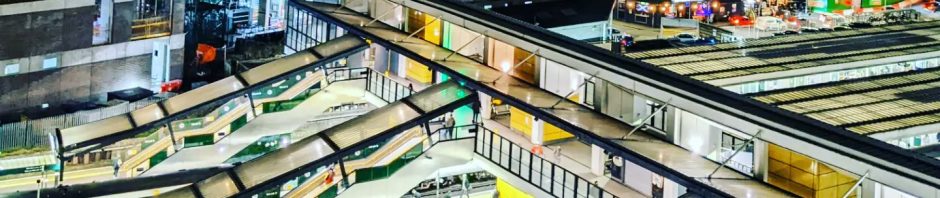

Open door policy: the Whitgift Foundation invited Westfield into Croydon in 2011. By 2026, URW had taken over most of the town centre
The £1billion regeneration of Croydon town centre has been plagued by a decade and a half of developer delays, economic turmoil, a global pandemic and a complete reshaping of the original retail-led proposal into what, in its latest iteration of proposals amounts to a vast new dormitory town of 3,000 homes in sky-rise tower blocks.
Following today’s announcement that URW has bought the freehold of the Whitgift Centre for £31.5million, here’s the Inside Croydon timeline of how we got to where we are today – which is much as we were in 2011, just with more shops closed…
August 2011: Following the London riots, which badly affected Croydon, Mayor of London Boris Johnson committed £23million from the London Regeneration Fund to revitalise the high street. “Let’s make Croydon great again,” Johnson said at the time.

‘Make Croydon great again’: Boris Johnson
November 2011: Croydon Central MP Gavin Barwell, a governor of the Whitgift Foundation at that time, worked behind the scenes to attract Australian mall developer Westfield to Croydon. Barwell was backed by a Glee Club of Tory activists and his Conservative colleagues who were in charge of Croydon Town Hall, led by Mike Fisher and including Jason Perry as cabinet member for planning and regeneration.
2012 “The Marriage Made in Hell”: Westfield hijacked a Terry Farrell-designed plan by rival developer Hammerson. To resolve the bitter turf war, Mayor Johnson brought the leadership of both companies together to form a 50-50 joint venture known as the Croydon Partnership. They promised a £1 billion mega-mall and 600 flats to open by 2017.
November 2013: Croydon Council granted planning permission. Boris Johnson rubber-stamped the approval.
2015–2016: Not a single brick was laid. The targeted opening date slipped from 2017 to 2020, and then to 2021. Developers blamed land assembly hurdles, Compulsory Purchase Orders (CPOs), the changing economic climates, the public’s retail habits, even Brexit.
2017–2018: The project cost was officially revised upwards to £1.4billion. The updated masterplan, scaled up to include 1,000 homes, was approved by the new Mayor of London, Sadiq Khan, in 2018. Construction was promised to begin in 2019.

Keen supporter: former Tory MP Gavin Barwell
February 2019: Gavin Barwell (by then chief of staff to PM Theresa May) continued to champion the scheme, but local criticism grew as the core of the Whitgift Shopping Centre suffered severe “developer blight”—emptying out as retailers fled or refused to renew leases due to the looming demolition.
February 2020: Unibail-Rodamco-Westfield – URW —which acquired Westfield in 2018, removed Croydon from its global development pipeline. They cited changing consumer habits, the rise of online shopping, and the catastrophic impact of the covid-19 pandemic. The grand retail-first supermall project was effectively declared dead.
2021: The previously approved 2018 architectural plans expired. Meanwhile, the council’s finances had collapsed and Jo Negrini, who had been brought to Croydon in 2015 to work closely with Westfield on the development, had quit under controversial circumstances. The council now lacked the means to support massive infrastructure changes.

No more: the Croydon ‘Partnership’ was always an uneasy relationship
April-May 2023: URW took 100% control of the project by buying out Hammerson’s 50% stake in the Croydon Partnership. Trade magazines estimate that URW paid £70million to acquire Centrale from their developer rivals – almost £30million less than they had bought it for in 2011.
URW tore up the old plans to start with a “blank sheet of paper” focusing on a housing-led, mixed-use destination rather than a retail mega-mall.
October 2023: Westfield leadership admitted that completing the entire reimagined scheme could take up to 15 more years, potentially until 2038.
July 2025: Facing a €520million overspend on a project in Hamburg, URW leadership flagged to investors that they were looking to reduce capital risk and potentially sell off the Croydon development site entirely.
Late 2025: URW launched its sixth public consultation, branding Croydon’s town centre “The North End Quarter” or “The Croydon Project”. Architects Allies and Morrison unveiled a highly modified framework prioritising high-density residential towers and public squares.
URW delayed the submission of its comprehensive outline planning application from late 2024 to mid-2026.
 February 2026: URW submitted minor, cosmetic plans to refurbish the exterior facades and North End entrances of the Centrale. This, along with a few street-level kiosk refurbishments at the historic Allders frontage, represented the only physical work executed on the site since 2012.
July 15 2026: After years of being strung along, and with their property income reduced by two-thirds since before covid – and before Westfield started running the shopping mall – the Whitgift Foundation baled out by selling the Whitgift Centre and other holdings in central Croydon to URW for £31.5million. This was all too late to save the Old Palace girls’ independent school, which closed 12 months earlier, a victim of falling rolls and declining subsidies from the Foundation’s charity.
Read more: Charity lost £2m last year over closure of Old Palace School
Read more: Crumbling finances see troubled Foundation lose millions more
Read more: Planning application for Westfield scheme stalled to mid-2026
Read more: Westfield boss says Croydon scheme could take 15 more years

PAID ADS: To advertise your services or products to our 10,000 weekday visitors to the site, as featured on Google News Showcase, email us inside.croydon@btinternet.com for our unbeatable ad rates
- If you have a news story about life in or around Croydon, or want to publicise your residents’ association or business, or if you have a local event to promote, please email us with full details at inside.croydon@btinternet.com
 As featured on Google News Showcase
- Our comments section on every report provides all readers with an immediate “right of reply” on all our content. Our comments policy can be read by clicking here
 Inside Croydon is a member of the Independent Community News Network


An excellent presentation of the way the disaster developed.
Most of these points would be ignored by those involved, only Inside Croydon has the courage to set it out so honestly.
Thank you, Inside Croydon.
I don’t quite understand how this is good news as Jason Perry makes it out to be on his socials. URW have no pressure from anyone to deliver Westfield now. They can just sit on the freehold and do absolutely nothing and lose minimal amounts of money now
What use is a mayor if he has no power? Is he not able to compulsory purchase the site and sell it to a company willing to commit to redeveloping and reinvigorating the site within a specified timescale, with penalties for failure to do so? Or could he not increase the local business taxes paid by URW each year until URW are so squeezed they are forced actually to do something constructive? What other town centre is owned by such a company willing to let the place decay and deteriorate?
I thought the value of a mayor is that he would get things done to bring some prestige to Croydon. It could be such a vibrant town with its amazing diversity and good connections to London. I never see Perry do anything useful.
“Or could he not increase the local business taxes paid by URW each year until URW are so squeezed they are forced actually to do something constructive?” The legislation certainly exists for residential landlords who keep their residential properties empty to pay increased multiples of the council tax – but there is no similar legislation for commercial landlords. Perhaps we need to lobby Sarah Jones to suggest such legislation to the Labour Government but she needs first to vacate her current offices in the Whitgift Centre to avoid any semblance of a conflict of interests to her electorate.
Flatten the whole area and landscape it into a park.
Like Reigate and Horsham have. It will be good for the body and soul.
The article glosses over the fact that the Foundation wasn’t a passive victim but an early, active player whose choices helped lock Croydon onto the Westfield path.
It’s a timeline. It is not meant to be an analysis of the Westfield years. After all, we have done that several times in the past 15 years, always highlighting the conflict of interest in MP Gavin Barwell having such an influence through the Whitgift Foundation, while backed by his Glee Club of Tory activists and Conservative councillors (including some who were Whitgift governors at the time). And our timeline provides some pointers to contemporary reports from the time, including this: https://insidecroydon.com/2019/02/15/barwell-brexit-and-croydons-troubled-westfield-dream/.
Try clicking on some of the links.
So sick of the negativity spouted by this publication. I turn to the news in search of hopeful progress for the area and all these articles do is whine, moan and cry. I moved to the area last year, and desperately hope that the area improves. But this constant lefty barrage against the council and government is draining. It’s hard for the community to feel inspired and hopeful when the main media source just wants to drag them down. Keyboard warrior at best.
Sounds like someone has discovered that they were conned when they paid well over the odds for an “executive apartment” and the promised regeneration of Croydon proves to be nothing more than an old promise disappearing ever further over the horizon.
Crompton clearly doesn’t understand journalism. We exist to report facts, not to pander to developers or provide “hopeful progress for the area”.
Crompton should note that he has commented on a timeline of events covering the history of the woe-begotten Westfield involvement in Croydon. Facts. Facts that most Croydon residents have had to live with for much longer than just a year.